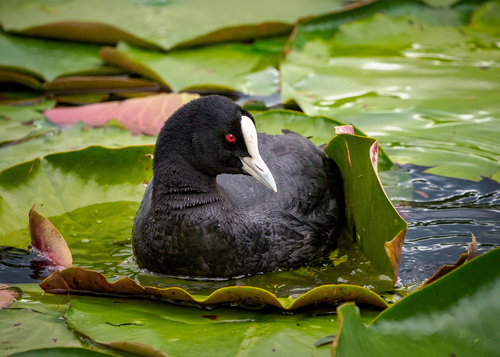
Eurasian Coot
Fulica atra
Recognizable by its coal-black plumage and stark white 'shield,' the Eurasian Coot is a feisty and fascinating waterbird. Whether they are diving for greens or defending their territory with a splashy chase, these birds are the true characters of the local pond.
Quick Identification
Size
32–42 cm (13–17 in) long; 75–100 cm (30–39 in) wingspan; 585–1,100 g (1.3–2.4 lbs)
Colors
Slaty-black body with a velvet-black head and neck; prominent white bill and frontal shield; striking red iris. Males and females are identical in plumage.
Key Features
- Bright white bill and frontal forehead shield
- Slaty-black plumage with red eyes
- Large grey-green legs with distinctive lobed toes
- Rhythmic 'pumping' head motion while swimming
When You’ll See Them
Geographic range
Where Does the Eurasian Coot Live?
The Eurasian Coot is a native resident across much of Europe, Asia, and North Africa, with significant populations also found throughout Australia and New Zealand. While populations in temperate climates like Western Europe and Australia stay put year-round, those in the colder regions of Russia and Northern Asia migrate south to the Mediterranean and Indian subcontinent during winter. They are highly successful colonizers of man-made water bodies, making them a common sight in urban and suburban environments worldwide.
Basemap © OpenStreetMap contributors
Behavior
The Eurasian Coot is a highly gregarious bird outside of the breeding season, often seen in large, noisy groups called 'rafts' on open water. They are notoriously territorial and aggressive when nesting, frequently engaging in 'pattering' across the water's surface—using their wings and large feet to chase away intruders. This feisty nature makes them one of the more entertaining species to observe in a wetland setting.
These birds are accomplished swimmers and divers, often disappearing underwater for several seconds to forage for vegetation. On land, they have a distinctive high-stepping gait due to their large, lobed toes, which are an evolutionary middle ground between a chicken's foot and a duck's webbed foot. They are also very vocal, producing a wide array of sharp, clicking, and popping sounds that can be heard day and night.
EverydayEarth exclusive
Camera Tips
To capture high-quality footage of Eurasian Coots, position your camera at the water's edge in a spot where the bank slopes gently. Coots frequently 'haul out' of the water to preen their feathers or rest on land. Setting your camera just 12-18 inches off the ground at an eye-level angle will produce much more professional, intimate results than looking down from a high tripod. Focus on areas with floating vegetation or near reed beds where they are likely to forage.
Since Coots are active swimmers, water movement can sometimes trigger 'false positives' on motion sensors. If your camera settings allow, adjust the PIR sensitivity to medium and use a 'zone' setting to focus on the shoreline rather than the moving water in the distance. They are most active during the morning and evening, so ensure your camera is not pointing directly into the rising or setting sun to avoid lens flare and silhouetting against the water's reflection.
During the spring breeding season (typically March through July), you can capture fascinating parental behavior by placing a camera near potential nesting sites in thick reeds. Coot chicks are famous for their bizarre, bright orange-red heads and 'old man' appearance, which makes for excellent video content. If you have a private pond, placing a few floating waterfowl pellets near the shore can reliably bring them into your camera's field of view for a close-up.
Similar Species
Species that look similar or are commonly confused with Eurasian Coot.
Frequently Asked Questions
Record Eurasian Coot at your habitat
Connect a camera to start building your own species record — AI identifies every visitor automatically.