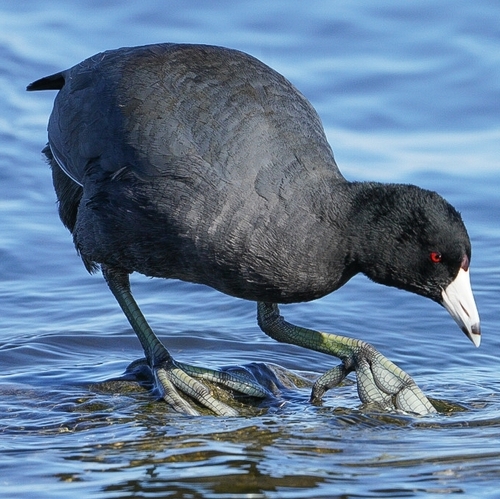
American Coot
Fulica americana
Often mistaken for a duck, the American Coot is a charismatic marsh bird with a striking white bill and a rhythmic head-bob. From their 'splattering' displays on the water to their unique lobed feet, they are one of the most entertaining species to watch in any wetland habitat.
Quick Identification
Size
Length: 32–43 cm (13–17 in); Wingspan: 58–71 cm (23–28 in); Weight: 427–848 g (0.9–1.9 lbs)
Colors
Dark charcoal-gray to black body with a blacker head and neck; prominent white bill and frontal shield with a small reddish-brown spot at the top.
Key Features
- Sharp triangular white bill with a small dark band near the tip
- Lobed gray toes instead of webbed feet
- Rhythmic head-bobbing motion while swimming
- Bright red eyes visible at close range
When You’ll See Them
Sightings on EverydayEarth
Apr 20, 2026
A Common Raven is perched on the edge of an elevated wire-mesh nesting platform, looking around and occasionally shifting its position. In the background water, several American Coots are swimming and foraging, creating ripples on the surface.
Apr 13, 2026
A group of American Coots is scattered across a calm marshy area. Several birds are seen swimming steadily, while one in the foreground dives briefly underwater to forage. The birds are actively moving through the channels between grassy banks.
Apr 13, 2026
A Great Egret stands motionless on the grassy left bank, surveying the marsh. In the center of the water channel, a small group of American Coots paddles slowly through the water, with several others visible further downstream.
Apr 13, 2026
A diverse group of waterfowl and shorebirds is active in a shallow marsh channel. American Coots and various ducks, including Northern Shovelers and Pintails, swim and forage in the water. Black-necked Stilts wade through the shallows, while a Great Egret stands watch in the distance. Occasionally, groups of birds take flight across the frame, showcasing the high level of activity in the wetland.
Apr 9, 2026
A diverse group of waterfowl is active in the marsh. Dozens of American Coots swim across the open water, while several male Northern Shovelers forage nearby. A male Northern Pintail is seen swimming toward the center of the frame, and a Great Egret wades slowly along the distant shoreline to the left.
Apr 9, 2026
A group of American Coots and Northern Shovelers are active in a shallow marsh. The coots are seen swimming and occasionally diving beneath the surface, while a pair of Northern Shovelers dabble for food nearby. In the background, tall reeds and bright yellow wildflowers line the water's edge under clear daylight.
Geographic range
Where Does the American Coot Live?
The American Coot is a quintessential North American water bird, with a range that stretches from the southern edge of the Canadian boreal forests all the way down to Panama. While they are year-round residents across most of the United States and Mexico, northern populations are migratory, flying south to the ice-free waters of the southern U.S. and the Caribbean during the winter months. These adaptable birds have also established presence in parts of northern South America, making them one of the most widespread members of the rail family in the Western Hemisphere.
Basemap © OpenStreetMap contributors
Behavior
These birds are versatile foragers, equally comfortable diving for aquatic plants as they are grazing on land. Their unique lobed toes provide excellent stability on soft mud and allow them to walk with much more agility than most waterfowl. In suburban settings, they are often seen walking across golf course fairways or park lawns near water, foraging for grass and seeds like miniature, dark-colored chickens.
EverydayEarth exclusive
Camera Tips
Lighting is critical when filming coots because their dark charcoal feathers can easily become a 'black hole' in high-contrast sunlight. Try to position your camera so the sun is behind it, illuminating the bird's white bill and red eye. If you are using an AI-powered camera, ensure the sensitivity is set to high; the dark silhouette of a coot against dark water can sometimes fail to trigger sensors in low-light conditions. Late afternoon light is particularly flattering for their plumage.
If you want to see their more dramatic behaviors, focus your lens on the boundary between open water and reed beds. This is where coots often engage in territorial disputes. While they aren't traditional 'feeder birds,' they are attracted to areas with cracked corn or waterfowl pellets scattered near the shoreline. During the spring, keep your camera active near submerged vegetation where they build floating nests; you might be lucky enough to capture their bizarre-looking, orange-headed chicks which look nothing like the adults.
Similar Species
Species that look similar or are commonly confused with American Coot.
Common Gallinule
Look for a bright red bill and frontal shield with a yellow tip, and a white stripe along the bird's side.
Eurasian Coot
Almost identical but lacks the dark reddish-brown callus at the top of the white bill shield.
Pied-billed Grebe
Smaller and more brown than gray, with a shorter, thick bill that has a vertical black stripe during breeding season.
Frequently Asked Questions
Record American Coot at your habitat
Connect a camera to start building your own species record — AI identifies every visitor automatically.