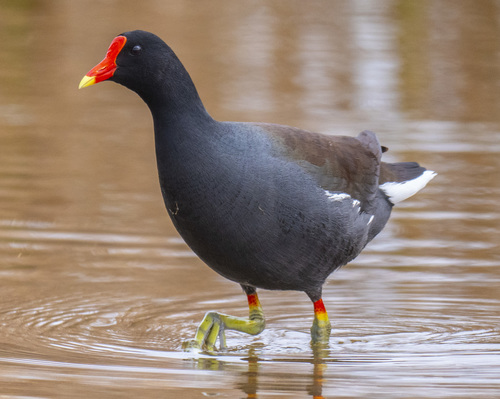
Common Gallinule
Gallinula galeata
With its striking red facial shield and oversized neon-green feet, the Common Gallinule is the charismatic 'swamp chicken' of American wetlands. Whether bobbing through lily pads or clucking from the reeds, this vibrant bird is a favorite for backyard pond watchers.
Quick Identification
Size
Length: 30–35 cm (12–14 in); Wingspan: 50–62 cm (20–24 in); Weight: 310–450 g (11–16 oz)
Colors
Sooty charcoal-gray body with a dark chocolate-brown back; distinctive white horizontal stripe along the flanks; bright red frontal shield and bill with a yellow tip; greenish-yellow legs.
Key Features
- Bright red facial shield and bill with a yellow tip
- White horizontal stripe along the flank
- Large, greenish-yellow feet with long toes and no webbing
- Jerky, rhythmic head-bobbing while swimming
When You’ll See Them
Geographic range
Where Does the Common Gallinule Live?
Native to the Americas, the Common Gallinule thrives across a vast territory stretching from the northern United States down through Central America and deep into South America. In North America, they are common year-round residents along the Gulf Coast and Florida, while populations in the Midwest and Northeast are typically migratory visitors during the summer breeding season. They are also widely distributed across the Caribbean islands and throughout the lowland wetlands of Brazil, Argentina, and Chile, making them one of the most widespread rail species in the Western Hemisphere.
Basemap © OpenStreetMap contributors
Behavior
Common Gallinules are social yet territorial birds often seen swimming in open water or walking across floating vegetation. Unlike ducks, they do not have webbed feet; instead, their long, slender toes distribute their weight, allowing them to 'walk on water' by stepping across lily pads and reeds. They are known for their distinct rhythmic head-bobbing while swimming and their frequent flicking of the tail, which reveals white under-tail feathers.
These birds are highly vocal, producing a wide array of croaks, clucks, and whinnies that often sound more like a barnyard than a marsh. While they can be secretive and retreat into dense reeds when threatened, they are relatively bold in suburban parks or golf course ponds, where they may become accustomed to human presence. During the breeding season, they are dedicated parents, often seen followed by 'fuzzy' black chicks with bright red heads and oversized feet.
EverydayEarth exclusive
Camera Tips
To capture the Common Gallinule on camera, focus on the 'transition zone' where water meets dense vegetation. These birds spend much of their time foraging at the edges of reeds or walking across floating mats of vegetation. Place your camera on a low-profile mount or a sturdy stake just 6 to 12 inches above the waterline. Angling the camera slightly downward toward a flat muddy bank or a frequently used opening in the cattails will provide the best perspective of their unique long-toed gait.
Because they are most active during the 'golden hours' of early morning and late afternoon, ensure your camera's trigger speed is set to its fastest setting to capture their jerky head movements without blur. If you are using a camera with video capabilities, 10-20 second clips are ideal for documenting their rhythmic swimming style and social interactions. In suburban settings, they are often attracted to backyard ponds; if you have one, placing the camera near a shallow entry point where they might come to drink or preen is highly effective.
While baiting isn't usually necessary if you find their natural paths, scattered birdseed or cracked corn near the water's edge can sometimes entice them to linger in front of the lens. Be mindful of seasonal changes; as water levels drop in late summer, gallinules may congregate around the remaining deep pools, making these 'hot spots' for camera placement. Always ensure your camera housing is waterproof and securely tethered, as rising water levels or curious wildlife could otherwise displace your gear.
Similar Species
Species that look similar or are commonly confused with Common Gallinule.
American Coot
The Coot has a white bill and lacks the red facial shield and white side-stripe of the Gallinule.
Purple Gallinule
Much more colorful with iridescent purple and green plumage and bright yellow legs.
Common Moorhen
The Old World counterpart; nearly identical but found only in Europe, Africa, and Asia.
Frequently Asked Questions
Record Common Gallinule at your habitat
Connect a camera to start building your own species record — AI identifies every visitor automatically.