Purple Gallinule
Porphyrio martinica
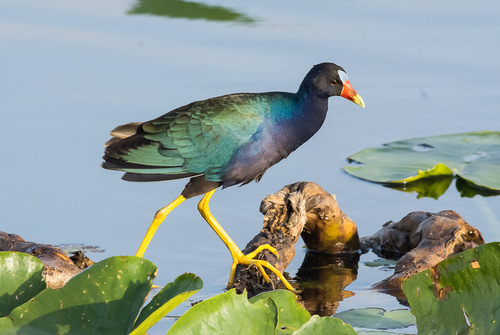
A dazzling kaleidoscope of color, the Purple Gallinule is a master of the marsh, walking effortlessly across lily pads with its oversized yellow toes. This vibrant 'swamphen' combines the elegance of a crane with the agility of a mountain climber.
Quick Identification
Size
Length: 27-36 cm (11-14 in); Wingspan: 50-55 cm (20-22 in); Weight: 200-300 g (7-11 oz)
Colors
Adults have iridescent purple-blue heads and underparts, a bronzy-green back, a light blue forehead shield, and a red bill with a yellow tip. Their legs are bright yellow. Juveniles are primarily buffy-brown.
Key Features
- Bright light-blue forehead shield
- Vibrant red bill with a yellow tip
- Extraordinarily long yellow toes for walking on lily pads
- Iridescent purple and green plumage
When You’ll See Them
Geographic range
Where Does the Purple Gallinule Live?
Native to the Americas, the Purple Gallinule is a jewel of the tropical and subtropical wetlands. Its core range extends from the southeastern United States and the Caribbean through Central America, reaching as far south as northern Argentina. While many populations in the tropics are year-round residents, those breeding in the northern parts of the Gulf Coast are migratory, traveling south for the winter.
Basemap © OpenStreetMap contributors
Behavior
The Purple Gallinule is often described as a 'swamp walker' because of its remarkable ability to navigate unstable environments. Using its exceptionally long, slender toes, it distributes its weight to walk across floating vegetation like lily pads and water hyacinths without sinking. Unlike many other water birds, they are also surprisingly agile climbers, often seen scaling shrubs or low trees near the water's edge to forage for seeds or fruit.
These birds are highly vocal and social during the breeding season, though they can be quite territorial. They are often seen bobbing their heads while swimming or flicking their white undertail feathers when walking. While they may seem shy, they are relatively bold once they grow accustomed to a human presence, provided there is plenty of cover nearby.
EverydayEarth exclusive
Camera Tips
To capture the stunning iridescence of the Purple Gallinule, camera placement is everything. Position your camera at a low angle, roughly 6 to 12 inches above the water level, focusing on a clear 'path' or opening among lily pads or floating vegetation. These birds are creatures of habit and will often use the same floating logs or vegetation mats as bridges to cross open water.
Because their plumage is so reflective, aim for locations that receive soft, indirect morning or late afternoon light. Harsh midday sun can wash out the deep purples and greens, making the bird look black or dark blue. If you have a backyard pond or a wetland edge, ensure the camera is triggered by motion near the shoreline, as they spend significant time foraging in the reeds and mudflats.
While they don't typically visit traditional bird feeders, you can attract them to a camera zone by maintaining a healthy wetland ecosystem. Planting native aquatic species like pickerelweed or water lilies provides the natural cover and food sources they crave. If your camera allows, use a high shutter speed to capture their frequent tail-flicking and head-bobbing movements without blur.
Similar Species
Species that look similar or are commonly confused with Purple Gallinule.
Frequently Asked Questions
Record Purple Gallinule at your habitat
Connect a camera to start building your own species record — AI identifies every visitor automatically.