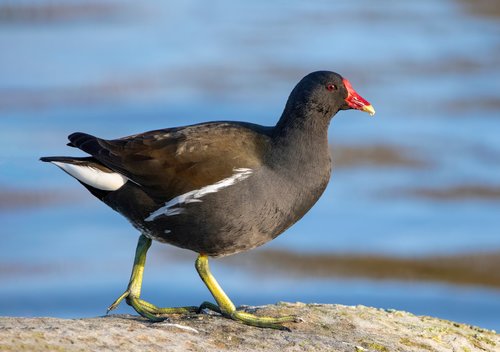
Common Moorhen
Gallinula chloropus
A familiar and bold face of the wetlands, the Common Moorhen is a master of the water's edge. With its bright red facial shield and distinctive bobbing gait, this adaptable bird is a joy to observe in any backyard pond or local marsh.
Quick Identification
Size
Length 30–38 cm (12–15 in); Wingspan 50–62 cm (20–24 in); Weight 190–490 g (6.7–17.3 oz)
Colors
Slate-gray to blackish body with a brown tinge on the back. Notable white line along the flanks and white outer tail feathers. Bill and frontal shield are bright red with a yellow tip. Legs are greenish-yellow.
Key Features
- Bright red frontal shield and bill with a yellow tip
- White horizontal stripe along the flank
- Frequent tail-flicking revealing white undertail feathers
- Greenish legs with long, unwebbed toes
When You’ll See Them
Geographic range
Where Does the Common Moorhen Live?
The Common Moorhen is native to the Old World, with a massive distribution spanning across Europe, Africa, and Asia. It is a common resident from the British Isles and the Mediterranean across to Japan and Southeast Asia, while also occupying almost all of Sub-Saharan Africa. While most populations are year-round residents, those in the colder northern regions of Russia and Central Asia migrate south to warmer climates during the winter to find ice-free water.
Basemap © OpenStreetMap contributors
Behavior
The Common Moorhen is an active and adaptable wetland bird known for its distinctive swimming style, which involves a rhythmic, jerky head-bobbing motion. Despite being members of the rail family—a group often known for being secretive—moorhens are relatively bold and frequently seen out in the open. They are equally adept at swimming, walking across floating lily pads, or foraging on land near the water's edge. Their long, unwebbed toes distribute their weight, allowing them to navigate soft mud and aquatic vegetation with ease.
Socially, they are territorial and can be quite vocal, producing a variety of croaking and clucking calls. During the breeding season, they may engage in aggressive displays against intruders, including other moorhens. They are also known for their cooperative breeding habits, where juveniles from an earlier brood may assist their parents in feeding and protecting the chicks of a subsequent brood in the same season. In urban environments, they often become habituated to humans and can be found in city park ponds and garden water features.
EverydayEarth exclusive
Camera Tips
To get the best shots of a Common Moorhen, place your camera at the very edge of the water, ideally near a gap in the reeds or vegetation. A very low mounting height—about 6 to 10 inches off the ground—is crucial. This 'bird's eye view' creates a more intimate and professional-looking image, capturing the vibrant red of their bill and their oversized green feet as they step through the mud.
Focus your camera on a specific 'landing' or 'basking' spot. Moorhens love to climb out of the water onto half-submerged logs or flat stones to preen their feathers. If your backyard pond lacks such a feature, adding a sturdy, moss-covered log that extends from the bank into the water will create an irresistible stage for your camera. Ensure the lens is clear of low-hanging grass, as even a single blade can trigger the motion sensor or cause the autofocus to blur the bird during a windy day.
While they are active throughout the day, the 'golden hours' of early morning and late afternoon provide the best lighting to highlight the texture of their dark plumage. Use a high-speed trigger setting or a burst mode of 3 to 5 frames, as moorhens are constant movers—their frequent tail-flicks and head-bobs can result in motion blur if the camera isn't set to capture rapid action. If you are using an AI-powered camera, ensure the sensitivity is set to 'high' to pick up their movement against the often-busy background of a marsh.
Similar Species
Species that look similar or are commonly confused with Common Moorhen.
Frequently Asked Questions
Record Common Moorhen at your habitat
Connect a camera to start building your own species record — AI identifies every visitor automatically.