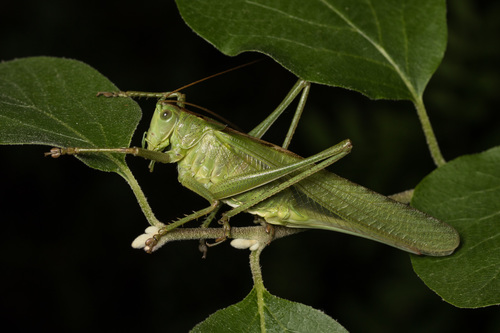
Great Green Bush-cricket
Tettigonia viridissima
The Great Green Bush-cricket is a stunning emerald giant of the insect world. With its incredible camouflage and a song that defines hot summer nights, this apex predator of the garden canopy is a must-see for any backyard explorer.
Quick Identification
Size
Body length 28-42 mm (1.1-1.6 inches); including wings, they can reach 50-60 mm (2-2.4 inches).
Colors
Brilliant leaf-green overall with a distinct brown stripe along the top of the head and thorax. Females feature a long, brownish-green sword-like ovipositor.
Key Features
- Impressive size up to 2 inches long
- Vivid emerald-green body with a thin brown dorsal stripe
- Wings that extend significantly past the end of the abdomen
- Females possess a long, straight, sword-shaped ovipositor
- Extremely long, thread-like antennae often exceeding body length
When You’ll See Them
Behavior
The Great Green Bush-cricket is a master of camouflage and one of the most charismatic insects of the summer garden. Unlike many of their ground-dwelling relatives, these bush-crickets are largely arboreal, preferring to spend their time high up in the canopies of trees, tall shrubs, or dense hedgerows. They are best known for the male's incredibly loud, mechanical-sounding song—a rapid 'tz-tz-tz-tz'—which can be heard from over 100 meters away on warm afternoons and well into the night.
Though they look like peaceful herbivores, these insects are actually formidable predators. They are solitary and territorial, often patrolling a specific bush or patch of vegetation. While they are capable of impressive leaps, they are also strong fliers, frequently moving between gardens to find mates or better hunting grounds. Despite their intimidating size and powerful mandibles, they are harmless to humans, though they may give a defensive nip if handled too roughly.
EverydayEarth exclusive
Camera Tips
To successfully capture the Great Green Bush-cricket on your backyard camera, you need to think vertically. These insects rarely spend time on the ground, so mounting your camera at eye level (4-5 feet) against a fence post, trellis, or a sturdy branch in a sunny hedge is your best bet. Because they are relatively small compared to mammals, positioning the camera within 12-24 inches of a known 'singing perch'—the highest point of a shrub—will result in the clearest footage.
While typical wildlife lures won't work, you can 'bait' a specific spot by creating a localized insect buffet. A small platform with a slice of overripe peach, plum, or melon can act as a magnet for these omnivores. Not only will the bush-cricket be attracted to the fruit itself, but the fruit will also attract the flies and small insects that the bush-cricket loves to hunt. Setting your camera to a 'macro' or close-focus mode is essential to capturing the detail of their vibrant green scales and waving antennae.
Lighting is your biggest challenge, as much of their activity occurs during the golden hour and after dark. If your AI camera has a high-quality infrared (IR) night vision mode, you can record fascinating nocturnal feeding behavior. For the best daytime results, ensure the camera is facing south to catch the sun hitting the foliage, which is where these insects love to bask. If your device allows for high-frame-rate recording, use it; the rapid vibration of the male's wings during stridulation is a spectacular sight when slowed down.
Similar Species
Species that look similar or are commonly confused with Great Green Bush-cricket.
Frequently Asked Questions
Record Great Green Bush-cricket at your habitat
Connect a camera to start building your own species record — AI identifies every visitor automatically.