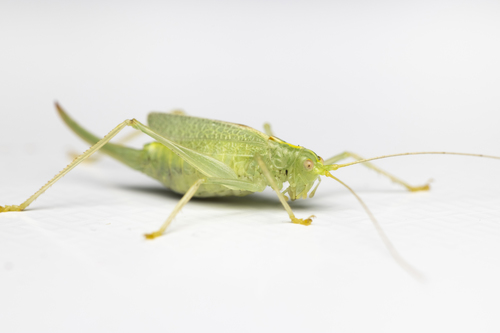
Oak Bush-cricket
Meconema thalassinum
The ghost of the canopy, the Oak Bush-cricket is a silent drummer that trades loud chirps for secret vibrations. This delicate, lime-green predator is a beneficial guest in any garden with mature trees.
Quick Identification
Size
Body length 12–16 mm (0.5–0.6 inches), with antennae often twice the length of the body.
Colors
Uniformly pale lime-green with a thin yellow or orange-tinted stripe running down the center of the back (pronotum). Eyes are typically pale yellow or white.
Key Features
- Pale lime-green translucent body
- Extremely long, thread-like antennae
- Wings extend past the end of the abdomen in both sexes
- Males lack the typical 'singing' equipment on their wings
- Females have a scimitar-shaped ovipositor
When You’ll See Them
Behavior
The Oak Bush-cricket is a secretive inhabitant of the canopy, spending the vast majority of its life high up in deciduous trees. Unlike most of its relatives in the katydid family, the males of this species are incapable of 'singing' by rubbing their wings together. Instead, they communicate through 'drumming,' rapidly striking a hind leg against a leaf to create a vibration that can be felt by others nearby. This makes them virtually silent to the human ear.
These insects are strictly nocturnal, hiding under the broad leaves of oaks and maples during the day to avoid birds. They are active hunters and quite agile, capable of quick bursts of flight if disturbed. While they are usually found in the treetops, they are frequently dislodged by heavy autumn storms, leading them to turn up on garden fences, walls, or even inside houses where they are attracted to the glow of indoor lighting.
EverydayEarth exclusive
Camera Tips
Capturing the Oak Bush-cricket on a backyard camera requires a strategy focused on verticality. Because they spend their lives in the canopy, a ground-level camera will rarely see them unless one has been knocked down by wind. Mount your camera on the trunk of a mature deciduous tree, or better yet, on a high fence or garden wall that sits directly under overhanging branches. They often use these structures as 'highways' when moving between feeding spots at night.
Because these insects are attracted to light (phototaxis), placing a camera near a porch light or a window that stays lit in the evening is a highly effective tactic. To get the best detail, use a camera with a close-focusing distance or a macro lens. Their pale green bodies are highly reflective, so if your camera uses a powerful infrared (IR) flash, you may need to diffuse the light with a small piece of semi-transparent tape to prevent 'white-out' on the cricket's body.
Set your camera to trigger on high sensitivity, as their movements are light and may not always trip a standard PIR sensor. Video mode is vastly superior to stills for this species; it allows you to observe the unique 'drumming' behavior where the male vibrates his leg against the surface he is standing on. Late summer and early autumn are the prime windows for observation, especially on humid, still nights when the crickets are most active in their search for mates.
Similar Species
Species that look similar or are commonly confused with Oak Bush-cricket.
Frequently Asked Questions
Record Oak Bush-cricket at your habitat
Connect a camera to start building your own species record — AI identifies every visitor automatically.