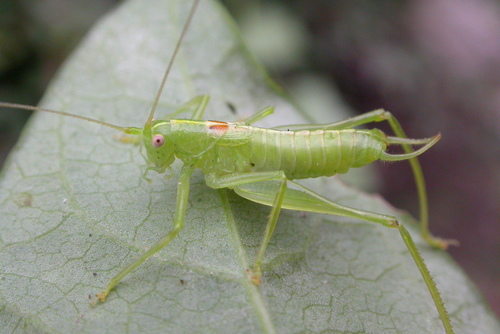
Southern Oak Bush-cricket
Meconema meridionale
The Southern Oak Bush-cricket is the 'silent drummer' of the insect world, using rhythmic vibrations rather than loud chirps to communicate. This flightless, lime-green master of camouflage is a frequent late-night visitor to garden walls and windowsills.
Quick Identification
Size
Body length typically ranges from 14 to 17 mm (0.55 to 0.67 inches) for both sexes.
Colors
A uniform pale lime-green across the body, often with a faint yellow or orange stripe running down the center of the back. Females are distinguished by a long, upward-curving, sword-like ovipositor.
Key Features
- Extremely short vestigial wings that do not function for flight
- Long, thread-like antennae that can reach twice the body length
- Pale translucent green legs
- Males have small, brownish cerci at the end of the abdomen
- Drumming behavior instead of audible chirping
When You’ll See Them
Behavior
The Southern Oak Bush-cricket is a remarkably stealthy and quiet insect, differing from most of its relatives by its lack of a vocal 'song.' Because its wings are so small, it cannot rub them together to stridulate. Instead, the male communicates by rapidly drumming its hind leg against a leaf or branch. This vibration is almost silent to human ears but travels effectively through the foliage to attract mates.
These insects are primarily arboreal, meaning they spend the majority of their lives in the canopy of deciduous trees. They are gentle and non-aggressive, often staying perfectly still to avoid detection by predators. Unlike many other grasshoppers or crickets, they are not strong jumpers and rely more on their slow, deliberate crawling and excellent camouflage to navigate their environment.
EverydayEarth exclusive
Camera Tips
Capturing the Southern Oak Bush-cricket on an AI-powered backyard camera requires a strategy focused on light and vertical surfaces. Because these crickets are flightless and nocturnal, they are frequently drawn to artificial light sources. Placing your camera near a porch light, an illuminated window, or a white garden wall is the most effective way to get a clear shot. They often rest on flat, light-colored surfaces after dark during the late summer months, where their green bodies provide a sharp contrast for the camera's sensor.
If you are placing a camera in a more wooded area of the yard, aim it at the trunk of a mature oak or fruit tree at about eye level. Since these insects are small, you will need a camera with a good macro focus or a high-resolution sensor that allows for digital zooming. Look for the 'hitchhiker' behavior; they often climb onto garden furniture or even the camera housing itself. Ensure your night-vision settings are optimized; because they are pale green, a strong infrared flash can sometimes overexpose them, turning them into a white blur. Reducing the IR intensity or using a camera with 'invisible' LEDs can help preserve the detail of their long antennae.
For those interested in their unique drumming, look for footage where the cricket appears to be 'shivering' or rapidly vibrating its body while standing on a leaf. To encourage them to stay within the camera's field of view, ensure you have broad-leafed shrubs like hydrangea or laurel nearby, as these provide the perfect 'sounding boards' for their drumming and are common hunting grounds for the aphids they eat. Late evening after a warm day is the prime time for activity.
Similar Species
Species that look similar or are commonly confused with Southern Oak Bush-cricket.
Frequently Asked Questions
Record Southern Oak Bush-cricket at your habitat
Connect a camera to start building your own species record — AI identifies every visitor automatically.