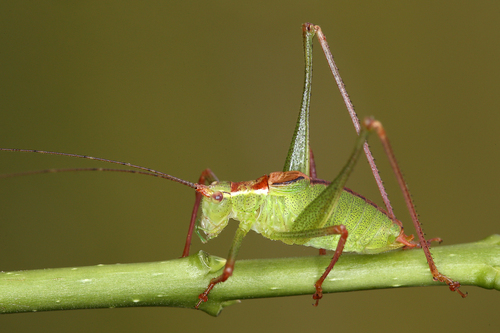
Speckled Bush-cricket
Leptophyes punctatissima
A master of garden camouflage, the Speckled Bush-cricket is a flightless wonder covered in a galaxy of tiny dark spots. Found tucked away in backyard brambles, these 'singing' gems are a delight to discover for any macro-wildlife enthusiast.
Quick Identification
Size
Body length of 10–20 mm (0.4–0.8 inches); antennae can be twice the body length
Colors
Bright leaf-green body covered in many tiny dark-brown to black speckles; males often have a brown stripe along their back
Key Features
- Flightless with vestigial, flap-like wings
- Tiny dark speckles across the entire body
- Long, thread-like antennae extending well past the body
- Female features a prominent, green, sickle-shaped ovipositor
- Sturdy hind legs adapted for jumping rather than flight
When You’ll See Them
Behavior
The Speckled Bush-cricket is a gentle, slow-moving insect that relies heavily on its remarkable camouflage. Unlike many of its cousins that take to the air when startled, this species is flightless. Its wings have evolved into tiny, rounded flaps that are primarily used for sound production rather than movement. During the day, they spend much of their time basking on large leaves or hiding within dense foliage to avoid predators like birds and spiders.
These insects are famous for their 'song,' though you likely won't hear it without help. Their stridulation consists of a very short, high-frequency chirp that sits mostly in the ultrasonic range. Because they can't fly, their social interactions are localized to the shrubs and brambles where they hatch, making them a consistent resident of a well-planted garden throughout the summer months. They are generally solitary but can be found in high densities where food is abundant.
EverydayEarth exclusive
Camera Tips
Capturing the Speckled Bush-cricket requires a specialized approach due to their small size and stationary nature. To get high-quality footage, you should mount your camera very close to 'host' plants like brambles, buddleia, or ivy. Since they are flightless, they tend to use the same 'highways' of stems and leaves every day. Look for flat, sun-exposed leaves at waist height; these are prime spots for afternoon basking and evening singing.
If your AI-powered camera has a macro mode or an adjustable focus ring, set it to its closest possible setting (usually 10-30cm). Because these crickets are triggered by movement, they may not always set off standard PIR sensors. Using a time-lapse mode—taking a photo every 30 to 60 seconds during the twilight hours—is often the most effective way to 'catch' them as they slowly move across a leaf or engage in their microscopic song.
Nighttime is when the real action happens. Use a camera with high-quality infrared (IR) night vision, as this species becomes much more active after sunset. They are attracted to the warmth of summer evenings, so focus your lens on the tops of shrubs where the air stays warm longest. Avoid using bright white-light flashes, which can startle them and cause them to drop into the leaf litter to hide.
If you want to lure them into frame, you don't need traditional bait. Instead, focus on habitat 'baits.' A small patch of wild bramble or a garden edge that isn't heavily pruned will naturally attract them. They are particularly fond of the underside of large leaves during the heat of the day, so angling your camera slightly upward toward the canopy of a shrub can reveal behaviors rarely seen by the casual observer.
Similar Species
Species that look similar or are commonly confused with Speckled Bush-cricket.
Oak Bush-cricket
Fully winged and can fly; lacks the dense black speckles of the Speckled Bush-cricket.
Great Green Bush-cricket
Much larger (up to 5cm), solid green, and possesses long wings that extend past the abdomen.
Dark Bush-cricket
Brownish-grey color rather than bright green, typically found lower in the vegetation.
Frequently Asked Questions
Record Speckled Bush-cricket at your habitat
Connect a camera to start building your own species record — AI identifies every visitor automatically.