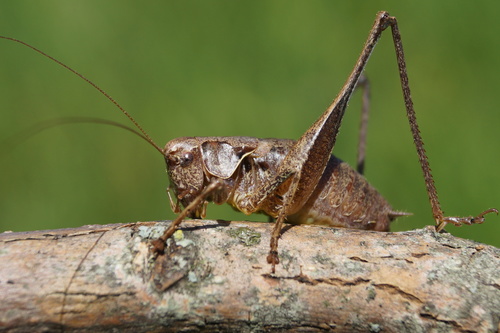
Dark Bush-cricket
Pholidoptera griseoaptera
The Dark Bush-cricket is a master of the garden undergrowth, known for its flightless agility and its sharp, rhythmic song that signals the height of summer.
Quick Identification
Size
Body length 13–20 mm (0.5–0.8 in); females have an additional 8–10 mm (0.3–0.4 in) curved ovipositor.
Colors
Dark brown to reddish-brown upper body with a contrasting creamy-yellow or pale green underside; males have small yellowish wing stubs.
Key Features
- Flightless with vestigial, scale-like wings
- Distinctive pale yellowish or lime-green belly
- Females possess a long, upward-curved, sword-like ovipositor
- Broad, robust body with long hind legs for jumping
When You’ll See Them
Geographic range
Where Does the Dark Bush-cricket Live?
Native to the European continent, the Dark Bush-cricket is one of the most widespread and successful orthopterans in the region. Its core range extends from the British Isles across Central Europe to the Balkans and the Caucasus mountains. It is a common resident in temperate zones, thriving particularly well in the scrubby margins and ecotones where woodland meets open ground.
Basemap © OpenStreetMap contributors
Behavior
The Dark Bush-cricket is a hardy and relatively bold insect often found in the tangled vegetation of garden borders and hedgerows. Unlike many of its more skittish relatives, this species is frequently seen basking on large leaves like bramble or nettle during the day. While they are flightless, they are agile climbers and powerful jumpers, using their strong hind legs to disappear into deep cover at the first sign of a predator.
Male Dark Bush-crickets are famous for their song, which is a very short, sharp 'tsick' sound repeated at irregular intervals. This chirping is produced by rubbing their tiny wings together and is most intense during warm afternoons and well into the evening. They are largely solitary but can exist in high densities where habitat is favorable, often forming a chorus that defines the sound of late summer in European countryside and suburban gardens.
EverydayEarth exclusive
Camera Tips
To capture the Dark Bush-cricket on camera, focus your efforts on 'edge' habitats. These insects love the vertical structure of brambles, nettles, and ivy. Mount your camera low—about 1 to 2 feet off the ground—and aim it at a sun-drenched patch of broad-leaved plants. Because they are small, a camera with a short minimum focal distance or a dedicated macro lens is essential to get a clear image. If your camera allows for focal adjustments, set it to the closest possible range.
While traditional baiting isn't usually necessary for bush-crickets, they are attracted to moisture and sugar. Smearing a small amount of 'moth sugar' (a mixture of fermented fruit, brown sugar, and beer) on a wooden post or a large leaf can draw them into your camera's field of view. This is particularly effective in the late afternoon as they begin their transition from basking to active foraging.
Timing is critical for this species. They are most active as adults from July through October. On warm, humid nights, they are more likely to be found higher up in the vegetation, making it a great time to mount cameras on fence posts or higher shrub branches. Since they are sensitive to vibrations, ensure your camera is mounted securely and won't wobble in the wind, which could trigger false recordings or scare the insect away before the shutter fires.
Similar Species
Species that look similar or are commonly confused with Dark Bush-cricket.
Frequently Asked Questions
Record Dark Bush-cricket at your habitat
Connect a camera to start building your own species record — AI identifies every visitor automatically.