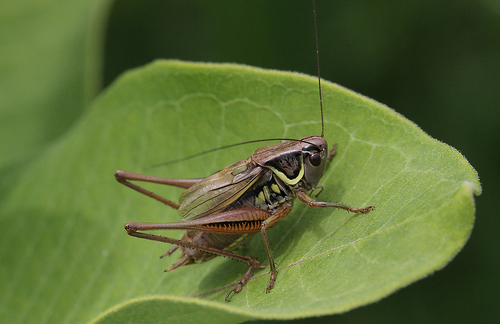
Roesel's Bush-cricket
Roeseliana roeselii
Listen for the electric hum of the meadow. The Roesel's Bush-cricket is a master of camouflage with a song that sounds like a mechanical vibration.
Quick Identification
Size
Body length of 15-26 mm (0.6-1.0 inches)
Colors
Usually yellowish-brown with a bright cream or neon-yellow 'U' shaped border and three distinct spots on the side of the thorax. Occasional green variants occur.
Key Features
- Three distinct cream-colored spots along the side of the pronotum
- Exceptionally long antennae, often twice the length of the body
- Distinctive high-pitched, mechanical buzzing song
- Broad, dark brown stripe running down the center of the head and back
When You’ll See Them
Behavior
Roesel's Bush-crickets are best known for their persistent, high-pitched stridulation, which sounds remarkably like a continuous electrical hum or a mechanical grass trimmer. Males climb to the tops of tall grass stems or seed heads to project this sound, using their wings to create the vibration. They are sun-lovers and require warm temperatures to remain active; on cloudy or cool days, they retreat into the dense thatch at the base of grass clumps.
While they are traditionally short-winged and flightless, this species exhibits a fascinating biological response to environmental changes. In exceptionally hot summers or in overcrowded populations, some individuals develop long wings. This 'macropterous' form allows them to fly and colonize new territories, which has contributed to their rapid range expansion across Northern Europe and the UK over the last several decades.
EverydayEarth exclusive
Camera Tips
To capture the Roesel's Bush-cricket on an EverydayEarth camera, focal distance is your biggest challenge. Because these insects are relatively small, you should position your camera as close to the vegetation as possible—ideally between 6 and 10 inches from a 'song post.' Look for the tallest, sturdiest grass stems in a sunny patch of your yard; these are the preferred stages for singing males.
Mount your camera at an angle that views the side of the grass stems rather than looking straight down. This side-on perspective is essential for capturing the diagnostic cream-colored spots on the thorax, which distinguish this species from other bush-crickets. Because they are triggered by solar heat, set your camera to its highest sensitivity during the peak afternoon hours. High-speed shutter settings are preferable if your camera allows, as their leg movements and wing vibrations are incredibly fast.
If you are struggling to find them, use your ears first. Locate the 'buzzing' sound in your garden and place the camera in that specific square meter. You don't need traditional bait, but you can encourage them to stay in the frame by providing a 'wild' corridor of long grass. If you want to increase the chances of a close-up, a tiny drop of sugar water or a slice of fresh fruit placed on a flat leaf near the camera can sometimes act as a temporary lure for a foraging individual.
Similar Species
Species that look similar or are commonly confused with Roesel's Bush-cricket.
Frequently Asked Questions
Record Roesel's Bush-cricket at your habitat
Connect a camera to start building your own species record — AI identifies every visitor automatically.