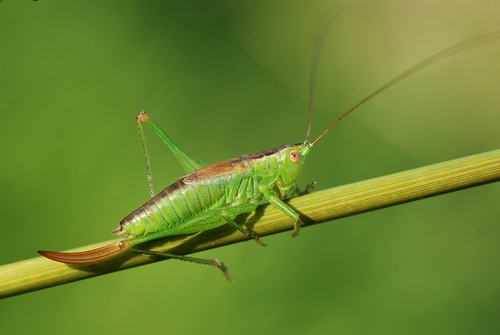
Short-winged Conehead
Conocephalus dorsalis
A gem of the marshland, the Short-winged Conehead is a vibrant green bush cricket that thrives in the humid micro-climates of wet meadows and pond edges.
Quick Identification
Size
Body length of 12-18 mm (0.47-0.71 inches); antennae can be twice the length of the body.
Colors
Bright emerald green body with a broad, dark brown longitudinal stripe running along the back from the head to the wing tips.
Key Features
- Bright emerald green body
- Dark brown stripe along the back
- Wings typically reach only halfway down the abdomen
- Long, slightly up-curved ovipositor in females
- Reddish-brown eyes
When You’ll See Them
Behavior
The Short-winged Conehead is a master of stealth and camouflage, spending most of its life clinging to vertical stems of reeds, rushes, and tall grasses. Unlike some more boisterous crickets, this species is relatively shy. When it senses a potential threat, it won't necessarily jump away immediately; instead, it expertly rotates its body to the opposite side of the grass stem, keeping the vegetation between itself and the intruder in a charming game of hide-and-seek.
Male coneheads produce a very high-pitched, buzzing song to attract mates, created by rubbing their wings together (stridulation). This sound is so high-frequency that many adults over the age of 40 may struggle to hear it without electronic assistance. They are generally solitary, though you may find several individuals inhabiting the same favorable patch of wetland vegetation during the peak of summer.
EverydayEarth exclusive
Camera Tips
Capturing the Short-winged Conehead requires a macro lens or a camera with a very short minimum focal distance. Because they are small and blend perfectly with green stems, your camera should be positioned low to the ground, ideally between 6 and 18 inches high. Aim your lens at vertical structures like Iris leaves, tall grasses, or reeds near water sources. Using a side-on angle is best, as it allows the camera to capture both the green body and the diagnostic brown stripe on the back.
For AI-powered trail cameras, high-sensitivity settings are a must. These insects don't provide much heat signature for PIR sensors, so time-lapse mode or video triggers based on motion detection in a specific zone are more effective. Set your camera to record in short, high-frame-rate bursts. This will help you see the incredibly fast vibration of the wings during stridulation, which often looks like a blur to the naked eye.
Lighting is your best friend. These crickets are most active when the sun is hitting the vegetation. If your camera setup allows, use a small external LED or a reflector to fill in shadows within the dense grass. If you are trying to attract them to a specific spot for filming, avoid chemical baits; instead, plant native wetland grasses or sedges. They are attracted to the structure of the plant more than any specific lure.
Be mindful of the wind. In a marshy environment, tall grass moves constantly, which can cause thousands of false triggers on a motion-sensing camera. If possible, use a support or a small clip to stabilize the specific stem you are focused on, or increase your camera's 'detection delay' to avoid filling your SD card with waving grass.
Similar Species
Species that look similar or are commonly confused with Short-winged Conehead.
Frequently Asked Questions
Record Short-winged Conehead at your habitat
Connect a camera to start building your own species record — AI identifies every visitor automatically.