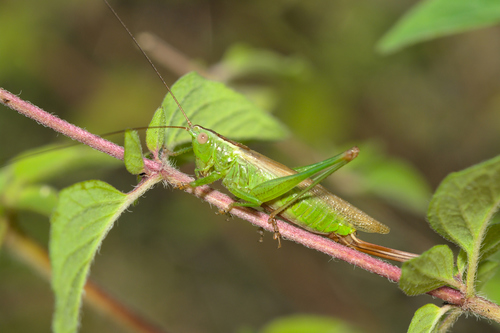
Long-winged Conehead
Conocephalus fuscus
A master of the summer meadows, the Long-winged Conehead is easily recognized by its pointed profile and vibrant green hue. Once restricted to coastal areas, this elegant flyer is now a common sight in wilder backyard spaces across temperate regions.
Quick Identification
Size
Adults typically measure 15–22 mm (0.6–0.9 inches) in length, excluding wings.
Colors
Bright grass-green body with a distinctive dark brown stripe running along the back; some rare individuals may be entirely light brown.
Key Features
- Conical-shaped head tapering toward the front
- Wings extend significantly beyond the end of the abdomen in adults
- Distinctive dark brown dorsal stripe from head to wing-tips
- Females feature a long, straight, sword-like ovipositor
When You’ll See Them
Behavior
The Long-winged Conehead is a shy and alert bush-cricket that relies heavily on its slender shape and green coloration to blend into tall grass. Unlike many other bush-crickets, this species is a strong flyer, using its fully developed wings to travel between habitats or escape predators. They are most famous for their 'song,' a very high-pitched, continuous buzzing sound that resembles a miniature mechanical drill, often audible only to younger ears or those using a bat detector.
While they spend most of their time perched vertically on grass stems, they are remarkably agile. When they sense a threat, they characteristically 'squirrel' around to the opposite side of a blade of grass to remain out of sight. They are generally solitary but can be found in high densities in prime habitats like unmown meadows during the peak of summer.
EverydayEarth exclusive
Camera Tips
Capturing the Long-winged Conehead on an AI-powered camera requires a specific focus on macro-environment placement. Because these insects live almost exclusively among tall stalks, your camera should be mounted on a low stake or tripod roughly 12 to 18 inches off the ground. Aim your lens toward a south-facing patch of long grass or reeds, as these insects prefer the warmest spots to sit and stridulate (sing) during the day. If your camera has adjustable focus, set it for a close range to ensure the intricate wing veins and conical head are sharp.
Since these insects aren't traditionally attracted to 'bait' like mammals are, your best bet is to provide a 'natural stage.' Look for prominent seed heads or tall stalks that stand slightly above the rest of the vegetation; coneheads often climb these to project their song. If you are in a suburban area, placing your camera near the edge of a garden pond or a 'no-mow' zone will increase your chances of a sighting. Because they are small, ensure your camera's motion sensitivity is set to the highest possible level, or use time-lapse mode to catch them as they move through the grass.
Timing is critical for photography. The best footage is often captured on bright, still days when the insects are most active and likely to move into the open. Side-lighting from the morning or late afternoon sun can create a beautiful translucent effect on their long wings, making them stand out against the green background. If your camera supports audio recording, listen for a constant, high-frequency hiss—if you hear it, the conehead is likely within a few feet of your lens, even if it is currently hidden behind a blade of grass.
Similar Species
Species that look similar or are commonly confused with Long-winged Conehead.
Frequently Asked Questions
Record Long-winged Conehead at your habitat
Connect a camera to start building your own species record — AI identifies every visitor automatically.