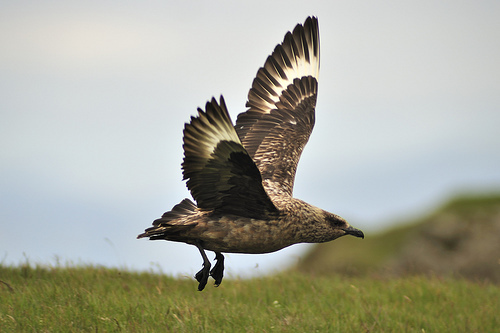
Great Skua
Stercorarius skua
The formidable 'Bonxie' is a master of the North Atlantic, known for its pirate-like aerial chases and fearless defense of its territory.
Quick Identification
Size
Length 50–58 cm (20–23 in); wingspan 125–140 cm (49–55 in); weight 1.1–1.6 kg (2.4–3.5 lbs)
Colors
Uniformly dark sepia-brown with golden or light-brown streaking on the neck and back. Prominent white flashes at the base of the primary flight feathers are visible in flight.
Key Features
- Heavy, barrel-chested build
- White 'flashes' on wings visible in flight
- Thick, hooked black bill
- Short, blunt tail with central feathers that do not project significantly
When You’ll See Them
Geographic range
Where Does the Great Skua Live?
The Great Skua is primarily a bird of the North Atlantic, with its core breeding populations found in Scotland (particularly Shetland and Orkney), Iceland, the Faroe Islands, and coastal Norway. They are highly maritime birds that spend the majority of their lives on the wing or on the water. During the winter, they migrate south across the Atlantic, reaching the coasts of Spain, North Africa, and occasionally venturing as far as the eastern United States and the Grand Banks of Newfoundland. Write engaging, crawlable prose suitable for an SEO-optimized section titled 'Where Does the Great Skua Live?'
Basemap © OpenStreetMap contributors
Behavior
The Great Skua, or 'Bonxie,' is a formidable and aggressive seabird known for its role as the apex predator of the northern skies. They are famous for their kleptoparasitic lifestyle, frequently harassing other seabirds like gannets and puffins in mid-air until they regurgitate their catch, which the skua then expertly catches before it hits the water.
During the breeding season, they are intensely territorial and fearless. They are well-known for 'dive-bombing' any intruder that approaches their nest on the coastal moorland, including humans and large dogs, often making physical contact with their feet or wings. Outside of the breeding season, they lead a more solitary life at sea, though they may congregate around fishing vessels to scavenge for offal.
EverydayEarth exclusive
Camera Tips
If you live in a coastal area near a breeding colony, capturing a Great Skua on camera requires a setup that can handle high-speed action and harsh weather. Place your camera on an elevated vantage point overlooking the sea or near coastal cliffs where these birds frequently patrol. Because they are often in flight, a camera with a fast trigger speed and high-frame-rate video capability is essential to catch their dramatic aerial maneuvers.
Great Skuas are highly territorial, so if you are setting up a trail camera near a suspected nesting site on moorland, ensure it is low-profile and well-secured. These birds have been known to investigate and even peck at unfamiliar objects in their territory. Mounting the camera on a heavy, low-to-the-ground stake rather than a high post may prevent it from being used as a perch, which could result in a lens full of bird droppings.
While we don't recommend baiting wild predators, placing a camera near natural 'scavenge sites' like a shore where fish frequently wash up or near a safe distance from a bird colony can yield excellent results. They are most active during the day, particularly when other seabirds are returning from fishing trips. Set your camera for 'burst mode' to increase your chances of capturing the moment they flash their distinctive white wing patches.
Similar Species
Species that look similar or are commonly confused with Great Skua.
Frequently Asked Questions
Record Great Skua at your habitat
Connect a camera to start building your own species record — AI identifies every visitor automatically.