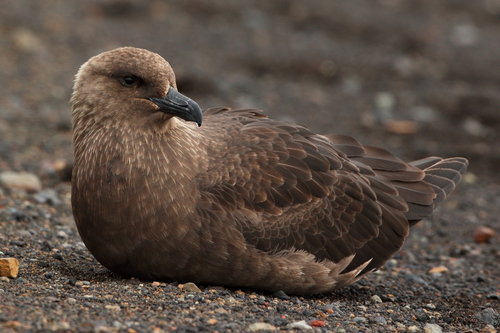
South Polar Skua
Stercorarius maccormicki
A legendary Antarctic voyager, the South Polar Skua is a powerful predator that ranges from the southern ice caps to the North Pacific. Known for its 'piratical' behavior and incredible migratory range, it is one of the most resilient birds on the planet.
Quick Identification
Size
Length: 50–56 cm (20–22 in); Wingspan: 127–140 cm (50–55 in); Weight: 900–1,600 g (2–3.5 lbs)
Colors
Polymorphic plumage ranging from pale grayish-buff to dark chocolate brown; all morphs feature striking white 'flashes' at the base of the primary wing feathers; dark gray bill and legs.
Key Features
- Prominent white patches at the base of the wings visible in flight
- Heavy, barrel-chested body with broad wings
- Thick, black bill with a sharp hooked tip
- Short, blunt tail compared to more slender jaegers
When You’ll See Them
Behavior
During their breeding season in the Antarctic, they are fiercely territorial. They will dive-bomb any intruder—including humans—that wanders too close to their nesting site. Outside of the breeding season, they undertake one of the most impressive migrations in the animal kingdom, traveling from the Antarctic ice edge deep into the Northern Hemisphere, often reaching the North Pacific and Atlantic oceans. They are generally solitary during these long oceanic journeys but are highly social and communicative when congregating at food sources.
EverydayEarth exclusive
Camera Tips
Capturing a South Polar Skua on an AI-powered camera is a specialized challenge because of their pelagic lifestyle. For the best results, place your camera on high coastal bluffs, rocky outcroppings, or near piers where seabirds are known to rest. Because these birds are attracted to high-vantage points to scan for food, a camera mounted 3 to 5 feet off the ground on a tripod or post—angled slightly downward toward a flat rock—is the ideal setup. In many coastal areas, they may follow fishing boats, so harbor-facing cameras often get lucky shots.
Since Skuas have a highly developed sense of smell and a natural curiosity, using a scent lure can be incredibly effective. A small amount of fish oil or fresh fish scraps placed securely within a rocky crevice (to prevent it from being carried away immediately) can draw them in for a close-up. If you are using an AI camera, set your trigger interval to 'shortest' and your burst mode to 3-5 photos; Skuas are fast-moving birds that may only land for a few seconds to investigate a scent before taking off again.
In terms of lighting, seaside environments often suffer from harsh glare and 'white-out' conditions. If your camera allows for exposure adjustment, slightly underexposing the image can help preserve the detail in the Skua’s white wing flashes, which are its most diagnostic feature. Focus your efforts during the late summer months if you are in the Northern Hemisphere, particularly after heavy storms which may push these ocean-dwelling birds closer to the shore. Early morning and late afternoon provide the best natural light for capturing the subtle brown and gray gradients of their plumage.
Similar Species
Species that look similar or are commonly confused with South Polar Skua.
Brown Skua
The Brown Skua is larger, heavier, and has a more uniform dark brown plumage with less contrast on the head compared to the South Polar Skua.
Pomarine Jaeger
Significantly more slender with a lighter build and longer, twisted tail feathers (in breeding plumage) compared to the stocky Skua.
Frequently Asked Questions
Record South Polar Skua at your habitat
Connect a camera to start building your own species record — AI identifies every visitor automatically.