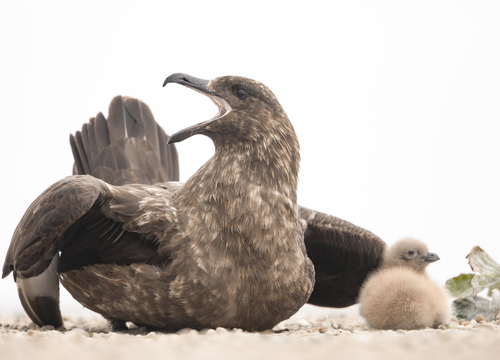
Brown Skua
Stercorarius antarcticus
Fierce, intelligent, and strikingly bold, the Brown Skua is the undisputed pirate of the southern oceans. Whether defending its territory or outmaneuvering other seabirds for a meal, this 'Antarctic raptor' is a marvel of subantarctic survival.
Quick Identification
Size
Length: 52–64 cm (20–25 in); Wingspan: 126–160 cm (50–63 in); Weight: 1.2–2.1 kg (2.6–4.6 lb)
Colors
Overall dark cinnamon-brown with pale buff or whitish streaking; conspicuous white patches at the base of the primary wing feathers.
Key Features
- Large, barrel-chested build with broad wings
- Heavy, black hooked bill
- Bright white 'flashes' on the wings visible in flight
- Dark, hawk-like appearance with powerful legs
When You’ll See Them
Sightings on EverydayEarth
Apr 13, 2026
A dense colony of Imperial Shags is seen nesting and interacting. Many birds are settled on raised mud nests, while others preen or adjust their positions. A Brown Skua walks through the lower-left section of the colony, causing nearby shags to watch it closely. The video contains two distinct segments with different lighting conditions.
Apr 6, 2026
Two Brown Skuas are visible on the rocky shoreline at dawn. One bird stands in the lower left throughout the sequence, while a second bird becomes clearly visible nearby as the morning light shifts. They remain mostly stationary, looking around the environment as waves crash against the shore in the background.
Apr 5, 2026
Several Brown Skuas are foraging and resting on the rocky shoreline of Isla Tova. In the foreground, one skua walks across the frame, while others remain stationary on the left, occasionally turning their heads. In the background, large waves crash against the coast under the fading light of late afternoon.
Apr 5, 2026
A Brown Skua is seen standing on the weathered rocks of the shoreline before taking flight. As it flies low across the frame, its large wingspan and white wing markings are clearly visible against the backdrop of the ocean waves.
Apr 2, 2026
A skua rests on the rocky ground in the foreground, occasionally adjusting its posture and looking around the colony. Behind it, a smaller bird walks across the terrain. The background shows a bustling scene at the edge of the ocean, where numerous seabirds are gathered along the waterline as waves crash against the shore.
Geographic range
Where Does the Brown Skua Live?
The Brown Skua is a master of the Southern Hemisphere's most rugged environments, claiming the subantarctic islands and the fringes of the Antarctic continent as its primary breeding grounds. These powerful birds are most commonly found on the Falkland Islands, South Georgia, the Kerguelen Islands, and the southern reaches of New Zealand and Argentina. When the harsh southern winter arrives, they embark on a northward migration that brings them to the coastal waters of Australia, South Africa, and much of South America, where they follow the nutrient-rich cold-water currents of the open ocean.
Basemap © OpenStreetMap contributors
Recorded on EverydayEarth
Behavior
Their social structure is fascinating; they are largely monogamous and return to the same nesting sites year after year. However, they are also highly opportunistic scavengers. Around research stations or fishing vessels, they are quick to learn schedules and can become quite tame, waiting for handouts or unattended food. Despite their aggressive reputation, they provide essential ecosystem services by cleaning up carrion and controlling populations of smaller burrowing petrels.
EverydayEarth exclusive
Camera Tips
While baiting is often restricted in sensitive polar environments, if you are in an area where it is permitted, oily fish scraps or meat trimmings are highly effective at keeping a skua in the frame. These birds are quick—sometimes too quick for standard trail cams—so use a high-speed trigger setting and consider using 'Burst Mode' or 'Photo + Video' to ensure you catch the moment they spread their wings to reveal their distinctive white patches. If you are near a petrel colony, you can even capture nocturnal hunting behavior using high-quality infrared flash, as skuas will hunt by moonlight to snag small birds returning to their burrows.
Lighting is your best friend when photographing these dark-plumaged birds. To avoid a 'black blob' effect, place your camera with the sun at its back to illuminate the cinnamon and buff streaks in their feathers. The golden hours of dawn and dusk in the southern latitudes provide the best contrast. Avoid placing cameras in deep shade or under thick scrub, as the skua's dark brown coloration will blend into the shadows, making it difficult for the AI to distinguish the bird from the background.
Similar Species
Species that look similar or are commonly confused with Brown Skua.
South Polar Skua
Smaller and slimmer than the Brown Skua, often with a paler, more grayish-brown plumage and a less heavy bill.
Chilean Skua
Identifiable by its distinct dark 'cap' and rich cinnamon-colored underwing coverts and belly.
Great Skua
Virtually identical in appearance but lives exclusively in the Northern Hemisphere; they never naturally meet in the wild.
Frequently Asked Questions
Record Brown Skua at your habitat
Connect a camera to start building your own species record — AI identifies every visitor automatically.