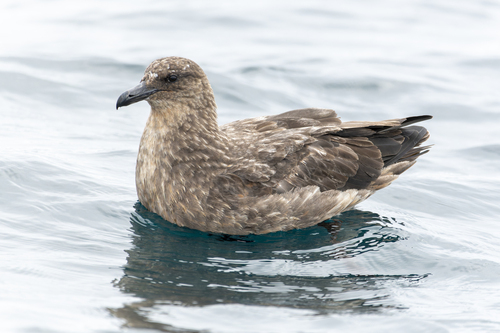
Chilean Skua
Stercorarius chilensis
The Chilean Skua is the bold, cinnamon-chested pirate of the Patagonian coast. Known for its fearless nature and aerial acrobatics, this predatory seabird is a master of the southern wind.
Quick Identification
Size
Length: 53–59 cm (21–23 in); Wingspan: 130–145 cm (51–57 in); Weight: 1.1–1.7 kg (2.4–3.7 lbs)
Colors
Rich cinnamon-brown throat and underparts; dark chocolate-brown cap and upperparts; white flashes on primary wing feathers
Key Features
- Distinctive cinnamon-colored throat and chest
- Dark chocolate-brown cap contrasting with face
- Large white patches on outer wings visible in flight
- Heavy, hooked black beak
- Broad, powerful wings and stocky build
When You’ll See Them
Geographic range
Where Does the Chilean Skua Live?
The Chilean Skua is a signature species of the southern tip of South America, with its primary breeding grounds located along the rocky coastlines and islands of southern Chile and Argentina, extending down to Tierra del Fuego. During the non-breeding season, these powerful flyers migrate northward along both the Pacific and Atlantic coasts. They are regularly spotted as far north as the coastlines of Peru and Uruguay, and occasional sightings occur along the southern beaches of Brazil, following the nutrient-rich cold water currents.
Basemap © OpenStreetMap contributors
Behavior
The Chilean Skua is often referred to as the 'pirate of the southern seas' due to its aggressive kleptoparasitic behavior. It frequently chases gulls, terns, and even larger boobies, harassing them mid-air until they disgorge their catch, which the skua then expertly snatches before it hits the water. Beyond piracy, they are formidable apex predators within their coastal niche, often working in pairs or small groups to raid penguin or cormorant colonies for eggs and chicks.
On land, they are highly territorial and bold, showing little fear of humans and often diving at intruders who venture too close to their nesting sites. They are social primarily during the breeding season, forming loose colonies on coastal cliffs or grassy slopes. Despite their fierce reputation, they are also opportunistic scavengers, often found patrolling beaches for carrion or congregating around fishing vessels to capitalize on discarded bycatch.
EverydayEarth exclusive
Camera Tips
To capture the Chilean Skua on a trail camera, focus your efforts on coastal vantage points. These birds love 'lookouts'—prominent rocky outcrops or high grassy mounds that overlook the ocean or a nearby seabird colony. Mount your camera on a sturdy post or rock face at a height of about 3 to 4 feet, angled slightly downward to catch them as they land or stand on their sentry posts.
Because skuas are highly attracted to movement and potential food sources, placing a camera near a natural focal point like a tide pool or a beach where kelp washes up can increase your chances. They are naturally curious and may even approach the camera to investigate; ensure your housing is rugged and securely fastened, as their powerful beaks can be destructive if they decide to sample the equipment.
For the best action shots, use a camera with a very fast trigger speed (0.2 seconds or less) and set it to 'Burst Mode' or 'Multi-Shot.' Skuas move quickly when they take off or land, and their flight is characterized by powerful, deep wingbeats. If your camera allows for adjustable PIR sensitivity, set it to high, as these birds often swoop in from high angles that might miss a less sensitive sensor.
In terms of timing, the early morning and late afternoon provide the best light for highlighting the rich cinnamon tones of their plumage. Avoid placing cameras in areas with heavy foot traffic, but don't be afraid to set them near busy coastal paths where skuas often scavenge for scraps. If you are in a non-breeding area, focus on estuaries and river mouths during the winter months (June to August).
Similar Species
Species that look similar or are commonly confused with Chilean Skua.
Brown Skua
Lacks the bright cinnamon underparts and has a more uniform, dark brown plumage overall.
South Polar Skua
Smaller and leaner with a more grey-brown appearance and less contrast between the cap and face.
Pomarine Jaeger
Significantly smaller with a lighter build and different tail structures; lacks the heavy, cinnamon-colored chest.
Frequently Asked Questions
Record Chilean Skua at your habitat
Connect a camera to start building your own species record — AI identifies every visitor automatically.