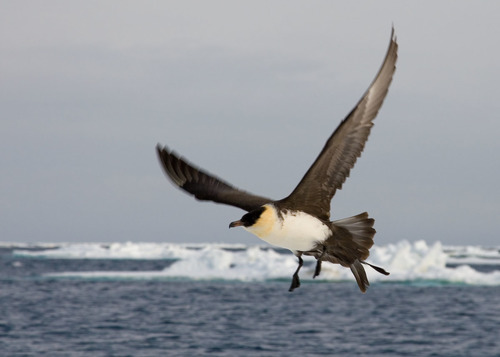
Pomarine Jaeger
Stercorarius pomarinus
The powerhouse pirate of the open ocean, the Pomarine Jaeger is a master of aerial pursuit. Known for its unique spoon-shaped tail and bold white wing flashes, this seabird is a rare and rewarding find for any coastal observer.
Quick Identification
Size
Length: 46-51 cm (18-20 in); Wingspan: 110-127 cm (43-50 in); Weight: 550-910 g (1.2-2 lbs)
Colors
Polymorphic plumage; light morphs have a dark cap, white underparts with a dusky breast band, and yellowish neck; dark morphs are entirely chocolate brown; both show white 'windows' on wings.
Key Features
- Broad, twisted, spoon-shaped central tail feathers in adults
- Heavy-chested and bulky build compared to other jaegers
- Bold white 'flash' at the base of the primary wing feathers
- Dark cap that contrasts sharply with pale cheeks in light morphs
When You’ll See Them
Behavior
During the breeding season on the Arctic tundra, their behavior shifts significantly. They become territorial hunters, focusing heavily on lemming populations. Outside of breeding, they are almost entirely pelagic, living solitary lives on the open tropical and subtropical oceans. They rarely come to land except to breed, making them a rare and exciting sight for coastal observers during migration or after heavy storms.
EverydayEarth exclusive
Camera Tips
The most effective strategy is to aim your camera toward areas of high bird activity. Jaegers are naturally drawn to feeding frenzies of gulls and terns. If you live near a harbor or a coastal area where fish processing occurs, setting up a camera overlooking the water can yield results. They are fast-moving targets, so setting your camera to its highest trigger speed and using 'Burst Mode' (capturing 3-5 photos per trigger) is essential to catch them in frame. High shutter speeds are necessary to freeze the motion of their wings and diagnostic tail feathers.
While you cannot attract them with traditional bird feeders, you can increase your chances by monitoring weather patterns. The best time to check your camera footage is immediately following a 'noreaster' or a tropical storm that has blown seabirds toward the coast. During these events, Jaegers may seek temporary shelter in bays or even large inland lakes, providing a unique window for photography.
Since they are diurnal, ensure your camera is optimized for daylight. Avoid using infrared flashes if possible, as they won't reach the distances required for over-water shots. Instead, focus on maximizing the 'Motion Sensitivity' setting to account for birds flying at a distance. If your camera allows for video, record in 60fps; this will allow you to slow down the footage later to confirm the identity of the bird by looking for those distinctive spoon-shaped tail feathers.
Similar Species
Species that look similar or are commonly confused with Pomarine Jaeger.
Parasitic Jaeger
Smaller and more agile with pointed, rather than blunt/spoon-shaped, central tail feathers.
Long-tailed Jaeger
Much smaller and slimmer with exceptionally long, flexible tail streamers and no breast band.
South Polar Skua
Significantly heavier and broader-winged, lacking the elongated central tail feathers entirely.
Frequently Asked Questions
Record Pomarine Jaeger at your habitat
Connect a camera to start building your own species record — AI identifies every visitor automatically.