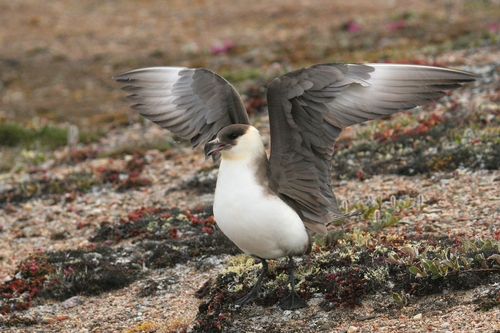
Parasitic Jaeger
Stercorarius parasiticus
Meet the Parasitic Jaeger, the agile 'pirate' of the northern skies. Known for stealing meals in mid-air, this sleek seabird is a master of high-speed aerial acrobatics.
Quick Identification
Size
Length: 16–19 in (41–48 cm); Wingspan: 42–49 in (107–125 cm); Weight: 11.6–21.5 oz (330–610 g)
Colors
Highly variable morphs ranging from uniform soot-brown (dark morph) to white-bellied with a dark cap and yellow neck wash (light morph). All show white flashes on the primary wing feathers.
Key Features
- Two short, pointed central tail feathers protruding past the tail edge
- White 'windows' or flashes at the base of the wing primaries
- Sleek, falcon-like silhouette with narrow, pointed wings
- Aggressive, acrobatic flight patterns during chases
When You’ll See Them
Behavior
The Parasitic Jaeger is often called the 'pirate of the sky' due to its fascinating feeding strategy known as kleptoparasitism. Rather than catching its own fish, it spends much of its time harassing other seabirds, like terns and gulls, in mid-air. Through high-speed chases and incredible aerial maneuvers, the jaeger forces its target to drop or regurgitate its meal, which the jaeger then catches before it hits the water.
On their breeding grounds in the Arctic tundra, they transition from pirates to fierce protectors. They are known for their social intelligence and aggressive defense of their nests. If a human or a predator approaches, these birds will dive-bomb the intruder with surprising speed or perform elaborate 'broken-wing' displays to lead threats away from their eggs. Outside of the breeding season, they are largely solitary and spend most of their lives over the open ocean.
EverydayEarth exclusive
Camera Tips
Capturing a Parasitic Jaeger on a backyard or trail camera is a unique challenge because they are almost exclusively coastal or tundra-dwelling. If you live on a coastal property, focus your camera placement on high vantage points like bluff edges, piers, or rooftops that overlook the water. These birds use these heights to scout for gulls and terns to harass. Set your camera at a slight upward angle (15-20 degrees) to capture the sky and the horizon, rather than just the ground.
Standard baiting rarely works for jaegers since they prefer 'stolen' or live prey. Instead, focus on attracting the birds they parasitize. If your camera is near a location where gulls naturally congregate, such as a bird bath or a flat coastal rock, you are much more likely to trigger a jaeger sighting. Because these birds move with incredible speed, you must use a camera with a very fast trigger speed (0.2 seconds or less) and a high-speed burst mode. If your camera supports it, set the shutter speed to at least 1/2000s to freeze the motion of their wings.
Timing is everything with this species. During the fall migration, they often follow the coastline closely. Check your camera logs during the morning hours (6-9 AM) when coastal thermal currents begin to rise, as jaegers use these to gain altitude. In terms of settings, ensure your 'sensitivity' is set to high; because they are often photographed against a bright sky, the camera needs to be sensitive to the fast-moving, dark silhouette to trigger properly.
Finally, consider the seasonal aspect. In many regions, you will only see these birds for a two-week window during their southward migration. Research local birding reports for 'jaeger sightings' and ensure your batteries are fresh and your SD cards are empty during those peak windows. For the best results, use a camera with 4K video capability, as the high-speed chase behavior is much more impressive in video format than in a still photo.
Similar Species
Species that look similar or are commonly confused with Parasitic Jaeger.
Pomarine Jaeger
Larger and heavier with blunt, 'spoon-shaped' central tail feathers rather than pointed ones.
Long-tailed Jaeger
Smaller with much longer, flexible tail streamers and lacks the heavy white wing flashes of the Parasitic.
Peregrine Falcon
Similar pointed-wing silhouette in flight, but has a distinct dark 'mustache' mark and lacks the jaeger's unique tail feathers.
Frequently Asked Questions
Record Parasitic Jaeger at your habitat
Connect a camera to start building your own species record — AI identifies every visitor automatically.