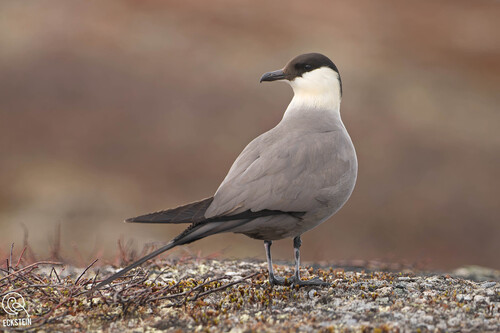
Long-tailed Jaeger
Stercorarius longicaudus
The Long-tailed Jaeger is the graceful acrobat of the Arctic skies, famous for its incredible migration and stunning, ribbon-like tail feathers. A fierce predator of the tundra and a master of the open ocean, it is one of the most elusive and beautiful seabirds in the world.
Quick Identification
Size
Length 19-21 in (48-53 cm) including tail; Wingspan 41-46 in (105-117 cm); Weight 8-12 oz (230-350 g)
Colors
Adults feature a distinct black cap, white chest and throat, and a yellowish wash on the neck. Their upper wings and back are grey-brown, while the belly is white. Immature birds are heavily barred in grey and brown.
Key Features
- Extremely long, flexible central tail streamers (up to 8 inches in adults)
- Smallest and most slender of the jaegers with a kestrel-like flight
- Cold-grey upperparts contrasting with black primary feathers
- Sharp, hooked bill for predatory feeding
When You’ll See Them
Geographic range
Where Does the Long-tailed Jaeger Live?
The Long-tailed Jaeger is a true globetrotter, native to the circumpolar Arctic regions of the Northern Hemisphere. During the short summer, they are found across the high tundra of Russia, Canada, Alaska, Greenland, and Northern Scandinavia. As winter approaches, these birds undertake an incredible migration, traveling thousands of miles south to spend the season over the nutrient-rich waters of the South Atlantic and Pacific Oceans, often reaching as far south as the coastlines of Chile and South Africa.
Basemap © OpenStreetMap contributors
Behavior
The Long-tailed Jaeger is the most elegant and agile of the skua family, often described as having a tern-like or kestrel-like flight. Unlike its larger relatives, it is less of a 'pirate' on its breeding grounds, though it still practices kleptoparasitism (stealing food from other birds) while at sea. During the summer months in the Arctic, they are highly territorial and will aggressively dive-bomb any intruders, including humans, who venture too close to their nests.
These birds are highly pelagic outside of the breeding season, meaning they spend the vast majority of their lives over the open ocean, far from land. They are generally solitary when at sea but congregate in the high tundra to breed. Their social interactions are limited primarily to pair-bonding and territorial defense, showcasing a fierce independence and mastery of the air.
EverydayEarth exclusive
Camera Tips
Capturing a Long-tailed Jaeger on camera requires patience and specific geographical placement. If you are in the Arctic tundra during the summer, place your AI-powered camera on a natural high point, such as a rock outcrop or a small mound. These birds use these 'lookouts' to scan the ground for lemmings. Because they are highly territorial, a camera placed near a suspected nesting site (at a respectful distance) will likely capture frequent fly-bys and defensive displays.
Since these birds are incredibly fast and agile, set your camera to the highest possible shutter speed or 'Sports Mode.' For AI detection, ensure the camera is angled slightly upward to capture their silhouette against the sky, as their long tail streamers are their most diagnostic feature. During the 24-hour Arctic daylight, you don't need to worry about infrared flash, but watch for harsh midday glares which can wash out the subtle grey tones of their plumage.
If you are monitoring from a coastal 'backyard' during migration, aim your camera toward the ocean on days with strong onshore winds. These 'pelagic' birds are occasionally blown closer to land. Use a telephoto lens attachment if possible, as they rarely land on suburban structures. Baiting is not recommended for this species, but setting up your camera near a colony of Arctic Terns may capture a Jaeger in the act of 'pirating' a meal, providing a spectacular action shot.
Similar Species
Species that look similar or are commonly confused with Long-tailed Jaeger.
Parasitic Jaeger
Heavier build with shorter, pointed tail feathers and more prominent white wing patches.
Pomarine Jaeger
Much larger and bulkier with 'spoon-shaped' twisted tail feathers rather than thin streamers.
Arctic Tern
Similar size and tail shape, but has a red bill, white body, and lacks the dark cap and predatory behavior.
Frequently Asked Questions
Record Long-tailed Jaeger at your habitat
Connect a camera to start building your own species record — AI identifies every visitor automatically.