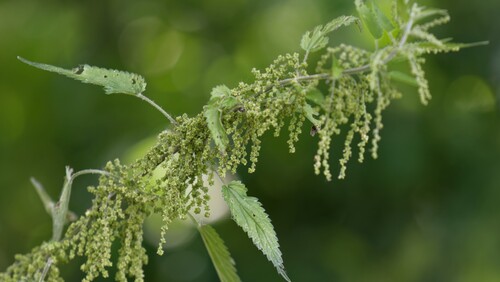
great stinging nettle
Plants diurnal

great stinging nettle

Urtica dioica

The Great Stinging Nettle is a misunderstood masterpiece of the backyard wild. A vital host for butterflies and a fortress for songbirds, this 'stinger' is a sign of a thriving, nutrient-rich environment.

0 Sightings
0 Habitats

Quick Identification

straighten

Size

Typically grows 1 to 2 meters (3 to 7 feet) tall; leaves range from 3 to 15 cm (1 to 6 inches) in length.

palette

Colors

Bright to dark green foliage; stems are square and sometimes tinged with purple or red; small, greenish-yellow flower clusters.

visibility

Key Features

  • Covered in tiny, hollow stinging hairs (trichomes)
  • Opposite, heart-shaped leaves with deeply serrated edges
  • Four-angled (square) upright stems growing in dense patches

When You’ll See Them

schedule
Activity pattern diurnal
brightness_5
Peak hours 10 AM - 4 PM (Peak time for associated insect activity and optimal sunlight for photography)
calendar_month
Season April - September
restaurant
Diet As a photosynthetic plant, it produces its own energy from sunlight; it is a 'nitrogen-lover' that thrives in phosphate-rich soils often found near human habitation or water sources.
park
Habitat Found in nutrient-rich, damp soils, suburban garden edges, woodland clearings, riverbanks, and farmyards.

bar_chart
Loading activity data...

Behavior

Stinging nettles are resilient perennials that function as the 'engine room' of a healthy backyard ecosystem. They are pioneer species, often the first to colonize disturbed ground where the soil is rich in nitrogen. While humans view them as a nuisance, they are highly social plants in a botanical sense, spreading through an extensive network of underground rhizomes to form large, protective colonies.

Within these patches, a complex set of interactions occurs. The plant uses its stinging hairs—essentially tiny silica needles filled with formic acid and histamine—to defend against large grazers. However, it is incredibly welcoming to smaller life forms. It serves as a vital nursery for several butterfly species and provides a dense, predator-proof thicket where small birds and mammals can forage in safety.

photo_camera EverydayEarth exclusive

Camera Tips

Capturing the life surrounding a stinging nettle patch requires a shift in perspective. Instead of treating the plant as a static object, view it as a high-traffic destination for wildlife. To capture the butterflies and caterpillars that call this plant home, mount your AI camera on a stake at mid-plant height (about 3 feet). Use a close-focus or macro setting if available, and aim the lens at the underside of the top leaves where Red Admiral or Comma butterflies often lay their eggs.

Lighting is your best tool for highlighting the plant's unique anatomy. Position your camera so it is 'backlit' by the early morning or late afternoon sun. This creates a glowing 'rim light' effect on the stinging hairs, making them stand out sharply against a darker background. If your camera has a time-lapse mode, set it to take one frame every 15 minutes during the spring growth spurt (May-June). You’ll be able to watch the stalks practically leap out of the ground in the final footage.

Don't forget the activity at the base of the plant. Because nettle patches are dense and provide excellent cover, they are frequently used as 'highways' by small mammals like hedgehogs or shrews. Place a second camera at ground level, angled slightly upward into the stalks. Since these areas are often shaded, ensure your camera’s infrared (IR) or low-light settings are optimized. Avoid using heavy baits directly in the nettles to prevent trampling the habitat; instead, place a water source nearby to encourage wildlife to move through the nettle patch toward the camera.

Frequently Asked Questions

The plant itself is most vibrant during peak sunlight (10 AM - 4 PM), which is also when you will see the most insect activity, such as butterflies and hoverflies. However, the base of the nettle patch becomes a hub for mammals like hedgehogs during the twilight and nighttime hours.
Nettles usually find their own way to any spot with nitrogen-rich, damp soil. You can encourage them by leaving a 'wild corner' in your garden near a compost heap or a spot that receives runoff. They prefer a mix of sun and partial shade.
Stinging nettles don't 'eat' in the traditional sense; they are autotrophs that use photosynthesis. However, they are heavy feeders of nitrogen and phosphorus, meaning they thrive where the soil has been enriched by compost, manure, or natural decay.
Yes, they are extremely common in suburban environments. They often pop up along fence lines, behind sheds, and in neglected garden borders where the soil hasn't been disturbed for a season or two.
Look at the flowers and the sting. Great Stinging Nettle has inconspicuous greenish flower clusters and will cause a painful sting when touched. Dead-nettles (Lamium species) have showy hooded flowers (often white, pink, or purple) and have no stinging hairs at all.

Record great stinging nettle at your habitat

Connect a camera to start building your own species record — AI identifies every visitor automatically.

Join free Identify a photo