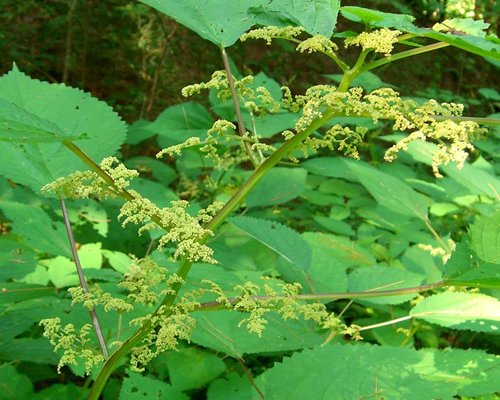
wood nettle
Laportea canadensis
The wood nettle is a powerhouse of the forest understory, offering a sting that demands respect and a habitat that sustains beautiful butterflies. This native perennial is an essential indicator of a healthy, moisture-rich backyard ecosystem.
Quick Identification
Size
Stands 30 to 120 cm (1 to 4 feet) tall, often forming dense, waist-high colonies in ideal conditions.
Colors
Vibrant medium-to-dark green foliage; stems and leaf ribs are covered in fine, translucent stinging hairs; small, inconspicuous greenish-white flower clusters.
Key Features
- Alternate leaf arrangement along the stem
- Large, egg-shaped leaves with sharply serrated (saw-toothed) edges
- Dense covering of stinging hairs (trichomes) on stems and leaf undersides
- Branching clusters of greenish-white flowers arising from the upper leaf axils
When You’ll See Them
Behavior
Wood nettle is a resilient perennial that defines the understory of moist North American woodlands. Unlike many garden plants, it possesses a sophisticated defense mechanism: tiny, hollow silica hairs called trichomes. When brushed against, these tips break off and inject a cocktail of formic acid and other irritants into the skin, causing a brief but intense stinging sensation. This allows the plant to thrive in areas where heavy grazing by deer might otherwise decimate the vegetation.
Ecologically, wood nettle is far more than a nuisance; it is a vital host plant for several butterfly species, most notably the Red Admiral (Vanessa atalanta). The larvae of these butterflies weave the large leaves together with silk to create protective 'tents' where they feed safely. In the late summer, the plant produces wind-pollinated flowers that lack showy petals, focusing its energy instead on seed production and spreading through its creeping underground rhizomes.
EverydayEarth exclusive
Camera Tips
Capturing the wood nettle effectively requires a shift in mindset from traditional wildlife photography. To document the plant's growth, set your AI-powered camera to a time-lapse mode during the late spring (May and June). Position the camera on a low tripod or a ground mount, roughly 12 to 18 inches off the forest floor. This low-angle perspective highlights the serrated edges of the leaves and the architectural structure of the stem, making for a much more dramatic image than a top-down view.
Because wood nettle is a primary host for the Red Admiral butterfly, focus your camera on the undersides of the leaves or look for 'folded' leaves held together by silk. If your camera has a macro or close-focus setting, this is the perfect opportunity to use it. Place the camera in a spot with dappled sunlight; the high contrast of forest light can make the translucent stinging hairs glow against a dark background, creating a stunning visual effect that clearly identifies the species.
If you are using a motion-triggered camera to capture the insects that visit the nettle, decrease the sensitivity to avoid triggers from wind-blown leaves, or use a 'zone' setting that focuses specifically on the flower clusters. No bait is needed for the plant itself, but ensuring the soil around it remains moist will keep the specimen looking vibrant and 'plump' for the camera throughout the hottest parts of the summer. Avoid placing the camera too close to the ground in very muddy areas, as rain splash can obscure the lens.
Similar Species
Species that look similar or are commonly confused with wood nettle.
Frequently Asked Questions
Record wood nettle at your habitat
Connect a camera to start building your own species record — AI identifies every visitor automatically.