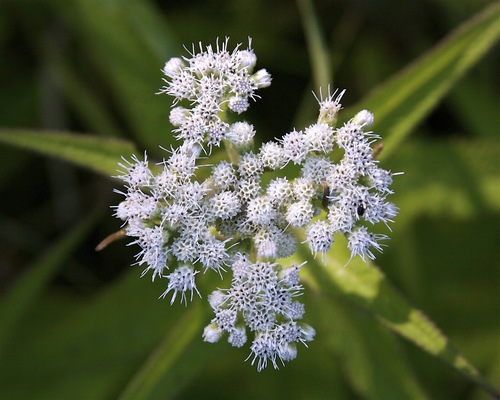
white snakeroot
Ageratina altissima
Transforming shaded corners into a sea of white, this resilient wildflower is a vital late-season sanctuary for pollinators and a fascinating link to American history.
Quick Identification
Size
Height ranges from 1.5 to 5 feet (45 to 152 cm); flower clusters are roughly 2 to 6 inches (5 to 15 cm) across.
Colors
Brilliant white flower heads; deep green foliage with light-colored, prominent veining.
Key Features
- Flat-topped clusters of fuzzy white disc flowers
- Opposite, heart-shaped leaves with sharply serrated edges
- Smooth, round stems that are light green or reddish-purple
- Prominent three-veined pattern on the upper leaf surface
When You’ll See Them
Behavior
White snakeroot is a hardy perennial that acts as a cornerstone of the late-summer and autumn woodland ecosystem. Unlike many wildflowers that require full sun to thrive, this species is highly shade-tolerant, often appearing in the dappled light of forest understories or the north-facing edges of suburban gardens. It is a colonial grower, spreading through both wind-borne seeds and a creeping rhizome system, which allows it to form beautiful, snowy patches in areas where other plants struggle to grow.
While it appears delicate, white snakeroot is famous for its chemical defense system. It contains a toxin called tremetol. Historically, when cattle grazed on this plant, the toxin was passed into their milk, causing 'milk sickness' in humans—a condition that famously claimed the life of Abraham Lincoln’s mother. Because of this toxicity, most mammalian herbivores like deer and rabbits avoid it, which is why it often remains untouched in backyards where other plants have been grazed to the ground.
EverydayEarth exclusive
Camera Tips
To capture the best images of white snakeroot, mount your AI camera on a low-profile tripod or a ground stake, positioning the lens approximately 2 to 3 feet high. This height aligns perfectly with the primary flowering heads of mature plants. Because the flowers are a brilliant, reflective white, they can often appear as 'blown out' white blobs in direct midday sun. For the most detailed shots, place your camera in an area of dappled shade or aim for the 'golden hours' of early morning or late afternoon when the light is softer and brings out the intricate, fuzzy textures of the florets.
Our unique camera data shows that white snakeroot is a high-traffic hub for pollinators. To document this activity, use a camera with a fast trigger speed or a dedicated 'Macro' mode. Position the camera about 12 to 18 inches away from a healthy cluster of open blooms. You can expect to see a variety of visitors including leafcutter bees, hoverflies, and even migrating Monarch butterflies. Since white snakeroot is one of the few plants blooming late in the season, it acts as a magnet for insects that are otherwise scarce in the backyard.
If you are using a motion-activated camera, set the sensitivity to its highest level. The movement of small insects like bees or beetles on the flower heads is often too subtle to trigger standard trail cameras. Alternatively, use a time-lapse setting to take a photo every 5 minutes during the peak of the afternoon. This not only captures the variety of insect life but also creates a beautiful visual record of the flowers opening and eventually turning into their fluffy, dandelion-like seed heads in late October.
Similar Species
Species that look similar or are commonly confused with white snakeroot.
Common Boneset
Boneset has long, tapering leaves that wrap completely around the stem, whereas white snakeroot leaves have distinct stems and are heart-shaped.
White Wood Aster
White wood asters have distinct yellow or red centers (disc florets) and visible petals, while white snakeroot flowers look like small, fuzzy white pom-poms.
Frequently Asked Questions
Record white snakeroot at your habitat
Connect a camera to start building your own species record — AI identifies every visitor automatically.