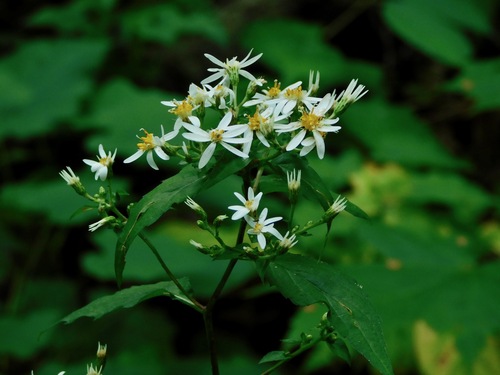
White Wood Aster
Eurybia divaricata
A resilient star of the shadows, the White Wood Aster illuminates the forest floor with its brilliant white blooms and unique zig-zagging stems. It is a vital late-season lifeline for pollinators and a must-have for any shade-heavy backyard sanctuary.
Quick Identification
Size
Height: 30–90 cm (12–36 inches); Spread: 60–120 cm (24–48 inches)
Colors
Brilliant white ray petals with centers that transition from bright yellow to deep reddish-purple; dark, burgundy-to-black stems
Key Features
- Distinctive zig-zagging (serpentine) dark stems
- Broad, heart-shaped leaves with sharp, saw-toothed edges
- Flat-topped clusters of star-like white flowers
- Thrives in deep shade where other flowers fail
When You’ll See Them
Behavior
One of its most fascinating 'behaviors' is the color-changing center of its blooms. After a flower has been successfully pollinated, the central disc shifts from yellow to a dusty red or purple. This serves as a biological 'no vacancy' sign, directing bees and butterflies toward the unpollinated yellow flowers, ensuring the plant reproduces efficiently while helping insects save energy. In the backyard, it is a polite neighbor, spreading reliably without becoming aggressively invasive.
EverydayEarth exclusive
Camera Tips
Capturing the White Wood Aster on camera requires a different approach than fast-moving fauna. Because these plants thrive in the shade, your biggest challenge will be lighting. To get those crisp, professional-looking shots of the white petals, position your camera during the 'golden hour' of late afternoon. The dappled light filtering through the tree canopy will provide a soft, natural spotlight that prevents the white flowers from looking overexposed or 'washed out' against the dark stems.
To capture the 'wildlife' aspect of this plant, set your camera on a low-profile stake or tripod just 12 to 18 inches off the ground. If you are using a motion-triggered camera to catch pollinators like the Silver-spotted Skipper or various bumblebees, set your sensitivity to the highest possible level. These insects are small and fast; a high-speed burst mode is essential to catch them in the act of nectar gathering. For the best results, aim the lens slightly upward from beneath a flower cluster to catch the intricate details of the insects' wings against the sky or canopy.
Don't overlook the power of time-lapse mode with this species. Setting your camera to take one photo every 20 minutes from late August through September can yield a stunning video of the 'bloom wave' as the forest floor transitions from green to white. Additionally, because the White Wood Aster is a favorite forage for White-tailed Deer in the early spring, placing a camera nearby during the budding phase can help you track local mammal activity as they come to snack on the nutritious young leaves.
Similar Species
Species that look similar or are commonly confused with White Wood Aster.
Frequently Asked Questions
Record White Wood Aster at your habitat
Connect a camera to start building your own species record — AI identifies every visitor automatically.