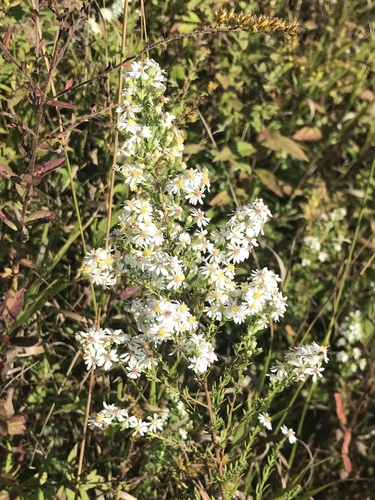
white heath aster
Symphyotrichum ericoides
Transform your autumn landscape with the 'snow' of the prairie. The white heath aster is a hardy, late-season powerhouse that provides a critical nectar feast for pollinators before winter sets in.
Quick Identification
Size
Typically 1 to 3 feet (30-91 cm) tall with a spread of 1 to 2 feet (30-61 cm). Individual flower heads are small, roughly 0.5 inches (1.3 cm) wide.
Colors
Masses of white ray flowers with bright yellow centers that often transition to reddish-brown or purple as they age; foliage is a dusty, grayish-green.
Key Features
- Dense, bushy growth habit with stiff, branching stems
- Tiny, narrow, needle-like leaves resembling heath or heather plants
- Massive clusters of small white daisy-like flowers appearing in late summer
- Spreads via underground rhizomes to form large, snowy drifts
When You’ll See Them
Behavior
White heath aster is a rugged, late-blooming perennial that transforms the autumn landscape into what looks like a light dusting of snow. Unlike many tall, floppy asters, this species has a stiff, almost shrub-like architecture that allows it to stand tall even in heavy winds. It is a strategic grower, sending out rhizomes to claim territory and blooming precisely when most other nectar sources have dried up for the season.
This plant is a social hub for the local ecosystem. During the day, it is a bustling marketplace for late-season pollinators, including honeybees, native bumblebees, and migrating butterflies like the Monarch. Because it is drought-tolerant and thrives in poor soil, it often pops up in neglected corners of suburban yards, roadsides, and meadows, providing a vital bridge for insects preparing for winter hibernation or migration.
EverydayEarth exclusive
Camera Tips
To capture the full glory of the white heath aster, place your camera at a low-angle, roughly 12 to 18 inches off the ground. This perspective captures the unique 'cloud-like' spray of the blooms against the sky or distant foliage. If you are using an AI-powered camera to identify visitors, aim the lens toward a dense cluster of flowers where the sun hits directly. The high contrast between the white petals and the dark foliage helps the AI trigger more accurately on the movement of visiting insects.
Because this plant is a pollinator magnet, we recommend using a 'Time-Lapse' mode during the peak hours of 11 AM to 2 PM on sunny September days. This allows you to condense hours of frantic bee and butterfly activity into a short, mesmerizing clip. If your camera has a macro or close-up setting, use it; the intricate details of the yellow disk centers (which change color after pollination) are stunning and provide great data for tracking the health of your local bee population.
Don't pack the camera away once the flowers fade. The white heath aster is often called the 'frost aster' because its dried seed heads and stiff stems look beautiful when coated in morning frost. Positioning your camera to catch the backlight of a rising sun will highlight the texture of the plant in late autumn and winter, and you might even catch small songbirds like goldfinches foraging on the dried seeds during the colder months.
Similar Species
Species that look similar or are commonly confused with white heath aster.
Frequently Asked Questions
Record white heath aster at your habitat
Connect a camera to start building your own species record — AI identifies every visitor automatically.