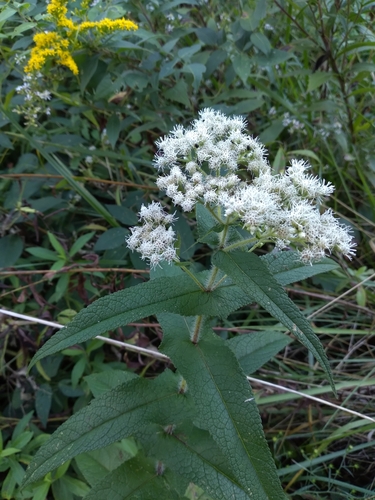
common boneset
Eupatorium perfoliatum
With leaves that seem to grow right through its stem, common boneset is one of the most distinctive wildflowers in the North American landscape. This wetland powerhouse is a favorite for pollinators and a historic staple of traditional herbal medicine.
Quick Identification
Size
Stands 60–120 cm (2–4 feet) tall with a spread of 60–90 cm (2–3 feet).
Colors
Bright green to grayish-green foliage with fuzzy, dull white to creamy white flower clusters.
Key Features
- Perfoliate leaves that appear to be pierced by the central stem
- Coarse, hairy stems and foliage
- Flat-topped clusters of fuzzy white disk flowers
- Opposite leaves joined at the base
When You’ll See Them
Geographic range
Where Does the common boneset Live?
Common boneset is a quintessentially North American wildflower, native to the vast eastern half of the continent. Its territory stretches from the Atlantic coast of Nova Scotia and New Brunswick southward to the humid reaches of Florida. To the west, the species thrives through the Great Lakes region and across the plains into Texas, Nebraska, and Manitoba, though it is notably absent from the arid mountain and desert regions of the western United States.
Basemap © OpenStreetMap contributors
Behavior
Common boneset is a hardy perennial that acts as a vital anchor in wetland ecosystems. It grows in upright clumps, spreading slowly via underground rhizomes to create dense patches of foliage. While it doesn't move like an animal, its 'behavior' is defined by its role as a high-traffic pollinator hub. From mid-summer to early autumn, it produces copious amounts of nectar that attract a staggering variety of beneficial insects.
In the backyard or wild space, boneset is a resilient survivor. Its leaves contain bitter compounds that make it highly resistant to deer and rabbit browsing. This allows it to thrive in areas where other wildflowers might be eaten, providing consistent structural cover for small amphibians like spring peepers and chorus frogs who hide among its moist, shaded lower leaves.
EverydayEarth exclusive
Camera Tips
To capture the best images of common boneset, focus your efforts during its peak blooming window from late July through September. Because this plant is a magnet for pollinators, your goal is likely to capture the 'action' on the flowers. Set your camera to a high-speed trigger mode or use a short-interval time-lapse to catch fast-moving bees, wasps, and butterflies that frequent the white clusters. If your camera allows for macro settings, position the lens within 12 to 18 inches of the flower heads.
Stability is crucial when photographing boneset because it typically grows in soft, saturated soil where stakes may shift. Use a tripod with wide feet or mount your camera to a nearby solid structure like a fence post or a heavy log. For the best lighting, aim for the 'golden hour'—the hour after sunrise or before sunset. The low-angle light catches the tiny, stiff hairs on the stems and the texture of the wrinkled leaves, creating a beautiful halo effect that identifies the species instantly.
Don't stop recording when the sun goes down. Many specialized moths and nocturnal beetles visit boneset after dark. Ensure your camera's infrared (IR) flash is enabled for night shots. If you are placing a camera specifically to monitor this plant, try to include the base of the plant in the frame; you may catch glimpses of wetland-dwelling reptiles or amphibians using the dense, moist foliage for cover during the heat of the day.
Similar Species
Species that look similar or are commonly confused with common boneset.
Frequently Asked Questions
Record common boneset at your habitat
Connect a camera to start building your own species record — AI identifies every visitor automatically.