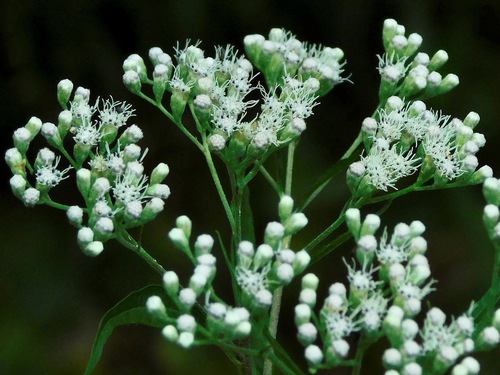
late boneset
Eupatorium serotinum
The late-season champion of the pollinator garden, late boneset provides a stunning white backdrop and a critical nectar source for autumn wildlife. Its tall, fuzzy blooms are a magnet for butterflies, making it the perfect focal point for your backyard camera.
Quick Identification
Size
3 to 6 feet (0.9 to 1.8 meters) in height; leaves are 2 to 8 inches (5 to 20 cm) long
Colors
Dusty white to creamy flower heads; deep green foliage; grayish-green stems with fine hairs
Key Features
- Flat-topped clusters (corymbs) of small white tubular flowers
- Opposite, lance-shaped leaves with prominent teeth and short stalks
- Erect, grayish stems covered in fine, downy pubescence
- Blooms significantly later than other bonesets, typically starting in late August
When You’ll See Them
Behavior
Late boneset is a late-season powerhouse that serves as a vital bridge for pollinators when other summer blooms have faded. As a perennial herb, it remains relatively inconspicuous during the early summer, focusing its energy on growing tall, sturdy stems. Once late August arrives, it erupts into broad, fuzzy white flower clusters that can remain vibrant well into October. It is known for its incredible ability to attract a diverse 'who's who' of the insect world, from migrating Monarch butterflies to beneficial predatory wasps.
In a backyard setting, late boneset acts as a social hub for wildlife. While the plant itself is stationary, its rhythmic life cycle dictates the activity of the creatures around it. It is highly resilient, often thriving in disturbed soils where other plants struggle, and it spreads gently through wind-dispersed seeds in the fall. For the backyard observer, it provides a consistent, multi-week window to observe complex insect interactions, including territorial displays by bees and the slow, methodical foraging of beetles.
EverydayEarth exclusive
Camera Tips
To capture the best action on late boneset, treat the flower heads as a 'stage.' Because this plant can reach heights of 6 feet, avoid using standard ground stakes for your camera. Instead, mount your camera on a nearby fence post or a tall tripod, angling it slightly downward toward the flat-topped flower clusters. This 'birds-eye' perspective is ideal for capturing the wing patterns of butterflies and the busy movement of bees as they crawl across the tiny florets.
Lighting is the biggest challenge when photographing white flowers. Late boneset’s bright white blooms can easily become 'blown out' in direct midday sun, losing all detail. Position your camera so the sun is at a 45-degree angle to the plant, or better yet, aim for the 'golden hour' shortly after sunrise or before sunset. If your AI-powered camera allows for exposure adjustments, bumping it down slightly (-0.5 or -1.0) will help preserve the intricate, fuzzy textures of the flower heads against the dark green leaves.
For the most exciting captures, use a high-sensitivity motion setting or, if available, a high-frame-rate video mode. Late boneset is a favorite of the Hummingbird Clearwing Moth, which moves with incredible speed; a standard photo might result in a blur, whereas video will reveal their fascinating hovering behavior. If you are targeting specific visitors like Monarchs, wait for a calm, sunny day with temperatures above 60°F, as this is when pollinator activity on the blooms will be at its absolute peak.
Similar Species
Species that look similar or are commonly confused with late boneset.
Common Boneset
Common boneset has leaves that completely surround the stem (perfoliate), whereas late boneset leaves have short but distinct stalks.
White Snakeroot
White snakeroot prefers deep shade and has wider, heart-shaped leaves compared to the narrow, sun-loving late boneset.
Tall Boneset
Tall boneset (Eupatorium altissimum) has leaves with only three prominent veins and fewer teeth than the heavily serrated late boneset.
Frequently Asked Questions
Record late boneset at your habitat
Connect a camera to start building your own species record — AI identifies every visitor automatically.