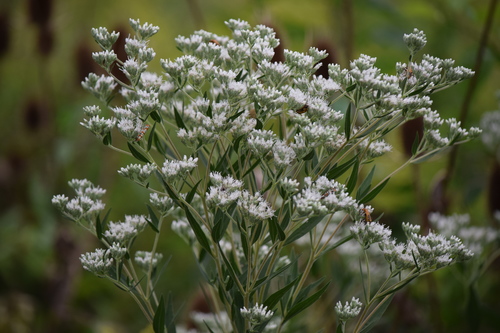
tall boneset
Eupatorium altissimum
A statuesque late-season bloom, tall boneset transforms sunny fields into bustling nectar stations. Its fuzzy white clusters are a magnet for migrating butterflies and a sign that autumn is on the horizon.
Quick Identification
Size
3 to 6 feet (0.9 to 1.8 meters) tall with leaves 2 to 5 inches (5 to 13 cm) long
Colors
Grayish-green foliage due to fine downy hairs; flower clusters are creamy white to bright white
Key Features
- Opposite lance-shaped leaves with 3 prominent veins
- Stems and leaves covered in soft, fine gray hairs
- Flat-topped clusters of small, white, fuzzy flower heads
- Robust, upright growth habit often reaching 5+ feet
When You’ll See Them
Behavior
Tall boneset is a hardy perennial that functions as a cornerstone of the late-summer ecosystem. Unlike many garden flowers that require staking, this species is structurally sound, holding its own against heavy winds and autumn rains. It spreads primarily through a deep, fibrous root system and wind-dispersed seeds, often forming small, attractive colonies in open spaces.
As a social hub for wildlife, tall boneset is rarely seen alone. From late August through the first frost, the plant is constantly 'busy,' hosting a rotating cast of pollinators. It is particularly noted for its high nectar production, which supports migratory butterflies like Monarchs as they prepare for their journey south. While it doesn't move, its presence dictates the activity patterns of dozens of insect and bird species in its vicinity.
EverydayEarth exclusive
Camera Tips
To successfully capture tall boneset on an AI-powered trail camera, placement is everything. Since the action happens at the very top of the plant, mount your camera on a stake or nearby post at a height of 4 to 5 feet. Tilt the lens slightly downward to overlook the flat-topped flower clusters. This 'bird's eye view' is the best way to get clear, identifiable shots of visiting butterflies, bees, and predatory insects that frequent the blooms.
Because tall boneset is a tall, flexible plant, wind can be your enemy by causing thousands of false triggers. To combat this, set your camera to 'Hybrid Mode' or use a higher PIR (Passive Infrared) trigger threshold. If your camera supports it, define a specific 'Zone of Interest' that focuses on the flower heads rather than the swaying stems. Alternatively, use a Time Lapse setting with a 1-minute interval during midday hours to document the impressive variety of species that visit throughout the day without filling your SD card with wind-blown foliage.
For the best image quality, position your camera so the sun is at its back—typically facing North or South—to avoid blowing out the white details of the flowers. The fine, silvery hairs on the leaves of tall boneset catch the light beautifully during the 'golden hour' (the hour before sunset), which is also a prime time for capturing clearwing moths. If you are using a trigger-based setup, a 3-shot burst is recommended, as pollinators move quickly between the small tubular flowers within the larger cluster.
Similar Species
Species that look similar or are commonly confused with tall boneset.
Frequently Asked Questions
Record tall boneset at your habitat
Connect a camera to start building your own species record — AI identifies every visitor automatically.