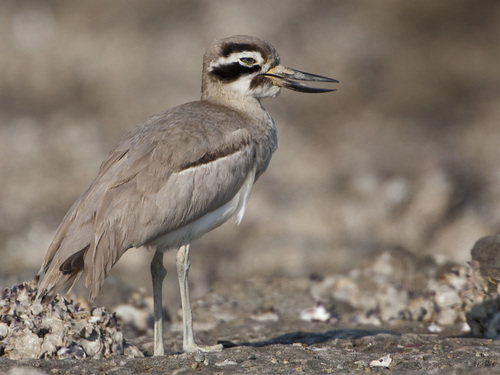
Great Stone-curlew
Esacus recurvirostris
With its massive bill and piercing yellow eyes, the Great Stone-curlew is a striking sentinel of Asia's riverbanks. This masterful hunter of the twilight blends perfectly into the gravel, coming alive under the cover of dusk.
Quick Identification
Size
Length of 49–55 cm (19–22 in); weight ranges from 700–1,100 g (1.5–2.4 lbs)
Colors
Sandy-grey and light brown upperparts with white underparts; distinctive black-and-white facial stripes and a yellow base on a black bill
Key Features
- Massive black-tipped yellow bill with a slight upward tilt
- Enormous bright yellow 'goggle' eyes
- Black mask and white forehead markings
- Long, thick-jointed pale yellow legs
When You’ll See Them
Geographic range
Where Does the Great Stone-curlew Live?
This impressive wader is native to the tropical regions of Southern and Southeast Asia. Its core populations thrive across the Indian Subcontinent, including India, Pakistan, Sri Lanka, and Bangladesh, extending eastward into Myanmar, Thailand, and parts of Indochina. While largely restricted to riverine systems in the interior, they are also found along suitable coastal stretches and rocky shorelines throughout their range.
Basemap © OpenStreetMap contributors
Behavior
The Great Stone-curlew is a master of stealth and camouflage, often spending its daylight hours standing perfectly still or crouching low among river stones to avoid detection. Despite its large size, its cryptic plumage allows it to blend seamlessly into gravelly environments. It is primarily crepuscular and nocturnal, becoming significantly more vocal and active as the sun sets, when its loud, mournful whistling calls can be heard carrying across the water.
Socially, these birds are typically found in pairs or small family groups, though they may gather in larger loose flocks at particularly rich feeding grounds. They are known for their wary nature and will often run a considerable distance with a hunched posture before taking flight if disturbed. During the breeding season, they are highly territorial of their nesting sites, which are nothing more than simple scrapes in the sand or shingle near water.
EverydayEarth exclusive
Camera Tips
To capture the Great Stone-curlew on camera, placement is everything. Since these birds are strictly ground-dwellers that prefer wide-open, stony areas near water, your camera should be mounted very low—no more than 12 to 18 inches off the ground. Aim the lens parallel to the substrate to capture their distinctive profile and enormous yellow eyes. If you are placing a camera near a riverbank or a property that borders a wetland, look for 'shingle' or gravel patches where they might rest or forage for crabs.
Because they are crepuscular and nocturnal, ensure your camera has a high-quality infrared (IR) flash that won't spook them. 'No-glow' or 'Black' IR is preferable, as these birds are extremely sensitive to light and movement. Set your trigger speed to the fastest possible setting; while they often stand still, their movements when hunting or striking at prey are lightning-fast. Using a burst mode of 3-5 photos or a short 10-20 second video clip is the best way to catch them in the act of using their powerful bills to crush a crab shell.
You don't necessarily need bait, but maintaining a clear, unobstructed 'runway' of gravel or sand can act as a natural lure. If you live in an area where they are present, avoiding high-frequency human activity near the camera site for several days is crucial, as they will avoid areas with fresh human scent or recent disturbance. During the breeding season (February to June), be extra cautious not to disturb potential nesting sites, as they lay eggs directly on the ground among the stones; always check the area carefully before approaching your camera for maintenance.
Similar Species
Species that look similar or are commonly confused with Great Stone-curlew.
Frequently Asked Questions
Record Great Stone-curlew at your habitat
Connect a camera to start building your own species record — AI identifies every visitor automatically.