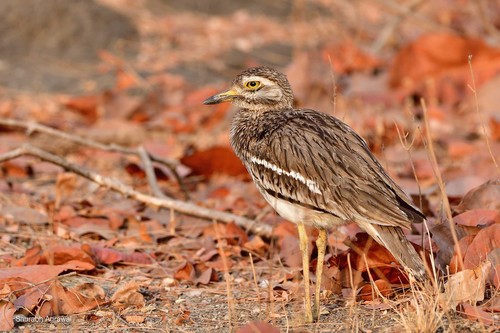
Indian Stone-curlew
Burhinus indicus
Masters of the art of invisibility, Indian Stone-curlews are the 'ghosts' of the dry plains. With their massive golden eyes and haunting evening calls, these fascinating birds are a prized capture for any backyard wildlife camera.
Quick Identification
Size
41–44 cm (16–17 in) in length; wingspan of 75–85 cm (30–33 in); weight approx. 400–500g (14–18 oz)
Colors
Sandy brown and buff upperparts with dark streaks; white throat and belly; prominent white stripe below the eye; large yellow irises
Key Features
- Enormous golden-yellow eyes
- Thickened 'knee' joints on long yellow legs
- Cryptic sandy-brown streaked plumage
- Heavy yellow-and-black bill
- Distinctive white wing patches visible in flight
When You’ll See Them
Geographic range
Where Does the Indian Stone-curlew Live?
The Indian Stone-curlew is a native resident of the Asian continent, primarily found across the Indian Subcontinent and parts of Southeast Asia. Its core population resides in India, Pakistan, and Sri Lanka, though it also ranges through Nepal, Bhutan, and eastward into Myanmar, Thailand, and Cambodia. This species thrives in the warm, dry lowlands of these regions, favoring open landscapes over dense jungles.
Basemap © OpenStreetMap contributors
Behavior
The Indian Stone-curlew is a master of camouflage, relying on its streaked brown plumage to disappear against stony ground and dry leaf litter. During the day, they are incredibly sedentary, often standing perfectly still or crouching low to the ground to avoid detection. If approached, they prefer to walk or run away stealthily rather than take flight, only taking to the air as a last resort.
As the sun sets, these birds undergo a personality shift, becoming highly vocal and active. They are well-known for their eerie, whistling calls that carry long distances in the night air. While they are usually found in pairs during the breeding season, they may gather in small, loose flocks during the day to roost in the shade of a large bush or tree.
EverydayEarth exclusive
Camera Tips
To capture the Indian Stone-curlew, place your camera at ground level or no higher than 12 inches (30 cm) off the ground. These are strictly ground-dwelling birds that rarely perch, so a low angle is essential for a full-body profile. Aim the camera toward open, flat areas with sparse vegetation or stony patches, as they prefer these 'runways' for foraging and moving between roosting sites.
Since this species is crepuscular and nocturnal, high-quality infrared (IR) night vision is a must. Standard white-light flashes might startle them, so 'no-glow' or 'low-glow' IR LEDs are preferred to capture their natural nighttime foraging behavior without causing flight. Set your camera for a fast trigger speed; while they stand still for long periods, their strike on an insect or their running gait is surprisingly quick.
If you are trying to attract them to a specific spot, a shallow ground-level water basin can be very effective, especially in drier climates. They are attracted to the insects that congregate around water sources. Position your camera near a known 'calling site'—areas where you hear their whistling calls at dusk—as they often return to the same patches of ground night after night.
During the breeding season (typically March to August), look for them in fallow fields or dry scrub. Be careful not to disturb potential nest sites, which are merely scrapes in the ground. Setting your camera to 'Burst Mode' or short video clips is recommended, as it allows you to observe their unique 'bobbing' head movements and the way they carefully scan the environment with those massive yellow eyes.
Similar Species
Species that look similar or are commonly confused with Indian Stone-curlew.
Frequently Asked Questions
Record Indian Stone-curlew at your habitat
Connect a camera to start building your own species record — AI identifies every visitor automatically.