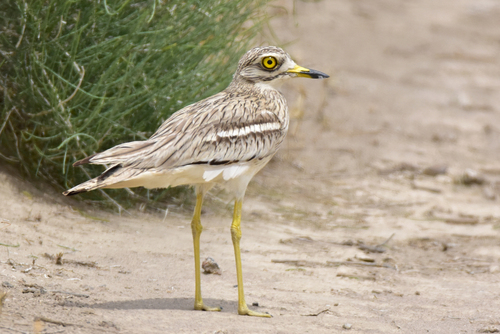
Eurasian Stone-curlew
Burhinus oedicnemus
With its piercing yellow eyes and a cry that haunts the moonlit heath, the Eurasian Stone-curlew is a ghost of the dry lands. This master of disguise is rarely seen by day, making it a prize catch for any backyard trail camera enthusiast.
Quick Identification
Size
Length: 40–44 cm (16–17 in); Wingspan: 77–85 cm (30–33 in); Weight: 300–600 g (10.5–21 oz)
Colors
Sandy-brown upperparts with dark streaks, white underparts, bold white wing-bars (visible in flight), and striking large yellow eyes.
Key Features
- Large, bulbous yellow eyes
- Thickened yellow leg joints ("thick-knees")
- Cryptic sandy-brown plumage with heavy streaking
- Short, stout yellow bill with a black tip
- Large white patches on wings visible during flight
When You’ll See Them
Geographic range
Where Does the Eurasian Stone-curlew Live?
Native to a broad swath of the Palearctic, the Eurasian Stone-curlew lives across southern and central Europe, North Africa, and South-West Asia. While populations in the Mediterranean and Middle East are often year-round residents, those breeding in northern countries like the United Kingdom, France, and Germany are migratory, flying south to Spain or Africa for the winter. They are highly specialized birds that depend on traditional grazing or specific farming practices to maintain the open, stony ground they require for nesting.
Basemap © OpenStreetMap contributors
Behavior
The Eurasian Stone-curlew is a master of camouflage and a bird of mystery. Primarily crepuscular and nocturnal, it spends the daylight hours crouching motionless on the ground, relying on its disruptive plumage to blend into stony or sandy soil. If approached, its first instinct is to freeze or 'flatten' against the earth rather than fly, making it incredibly difficult to spot with the naked eye.
As dusk falls, these birds become vocal and active, emitting a haunting, wailing 'cur-lee' call that can carry for miles across open heaths. While they are generally solitary or found in pairs during the breeding season, they can form larger, social 'post-breeding' flocks in the late summer and autumn before migrating south. They are ground-dwellers by nature, preferring to run quickly on their long legs rather than take to the air unless absolutely necessary.
EverydayEarth exclusive
Camera Tips
To capture the Eurasian Stone-curlew, camera placement is everything. Since these birds are strictly ground-dwellers and rely on bare patches of earth, position your camera very low—no more than 20 to 30 centimeters (8-12 inches) off the ground. Aim for a wide-angle view over a known 'scrape' or a flat, stony area where vegetation is sparse. They are creatures of habit and will often return to the same bare patches night after night.
Because they are most active during the twilight hours and at night, ensure your camera has a high-quality infrared (no-glow) flash. Traditional white flashes will likely spook these extremely wary birds, causing them to abandon the area. Set your PIR (motion) sensitivity to high, as their 'freezing' behavior means they may move very slowly or stay perfectly still for long periods before a sudden, quick walk through the frame.
If you are using a camera in a garden or farm setting near their habitat, you can sometimes encourage a visit by maintaining a patch of completely bare, weed-free soil. They are not easily 'baited' like other birds, but they are attracted to areas with high beetle activity. Ensure your camera is set to take a burst of 3-5 photos or a 15-second video, as their subtle movements and large, light-reflective eyes are best captured in motion under the IR light.
Similar Species
Species that look similar or are commonly confused with Eurasian Stone-curlew.
Eurasian Curlew
Much longer, decurved bill and lacks the large yellow eyes and thick leg joints of the Stone-curlew.
Senegal Thick-knee
Very similar in appearance but found in Africa; it has a more prominent grey wing panel and is more often associated with water.
Great Stone-curlew
Larger with a much more massive, heavier bill and a distinctively different facial pattern; native to South Asia.
Frequently Asked Questions
Record Eurasian Stone-curlew at your habitat
Connect a camera to start building your own species record — AI identifies every visitor automatically.