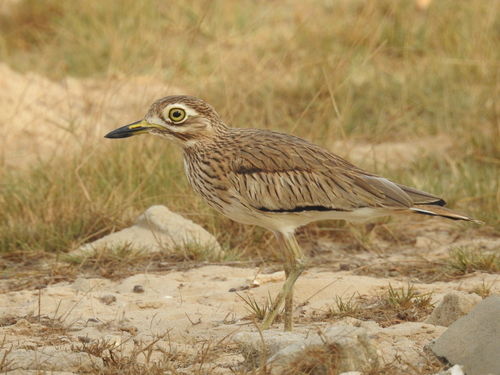
Senegal Thick-knee
Burhinus senegalensis
With its piercing yellow eyes and enigmatic nocturnal calls, the Senegal Thick-knee is a master of the twilight hours. Whether stalking through a savanna or nesting on a Cairo rooftop, this 'stone-curlew' is one of Africa's most charismatic and adaptable waders.
Quick Identification
Size
Length: 32-38 cm (12.5-15 in); Wingspan: 75-80 cm (29.5-31.5 in); Weight: 250-380 g (8.8-13.4 oz)
Colors
Streaked sandy-brown upperparts, white underparts, pale grey wing bar, yellow eyes, and greenish-yellow legs. Sexes are identical.
Key Features
- Extraordinarily large yellow eyes
- Prominent 'thick' joints on long greenish-yellow legs
- Short, stout bill with a yellow base and black tip
- Cryptic sandy-brown plumage with vertical dark streaks
When You’ll See Them
Geographic range
Where Does the Senegal Thick-knee Live?
The Senegal Thick-knee is a native of the African continent, found extensively throughout Sub-Saharan Africa from Senegal in the west to Ethiopia in the east. Its range also extends northward along the Nile Valley into Egypt, where it has become a celebrated urban resident. While primarily found in the tropical and subtropical belts, it is remarkably well-adapted to both arid riverbanks and humid coastal regions.
Basemap © OpenStreetMap contributors
Behavior
The Senegal Thick-knee is a master of stealth and camouflage, often spending its daylight hours standing perfectly still or crouching low to the ground to avoid detection. While they are capable flyers, they prefer to run from threats, using their long legs to navigate open terrain with surprising speed. They are well-known for their mournful, whistling calls that are most frequently heard during the twilight hours and on moonlit nights, often sounding like a rising and falling 'pi-pi-pi-pi-pi'.
These birds are highly adaptable and have become comfortable living alongside humans, particularly in urban environments like Cairo where they nest on flat rooftops. They are generally seen in pairs or small family groups. Despite their stone-curlew heritage, they are quite bold in suburban settings, provided they have a clear view of their surroundings to spot potential predators.
EverydayEarth exclusive
Camera Tips
To capture the best footage of a Senegal Thick-knee, place your camera at a very low height, ideally no more than 10 to 20 centimeters off the ground. These birds are terrestrial and spend most of their time walking or standing on flat surfaces. If you live in an urban area where they are known to frequent roofs, a wide-angle lens placed near the edge of a flat rooftop can yield spectacular results, as they often use these elevated positions for calling and nesting.
Because the Senegal Thick-knee is crepuscular and nocturnal, high-quality Infrared (IR) night vision is essential. Avoid cameras with a loud mechanical shutter or a visible red glow if possible, as they have excellent night vision and may become wary of the device. Set your trigger speed to the fastest possible setting; while they often stand still, their 'dash and freeze' movement pattern can easily result in a photo of a disappearing tail if the sensor is sluggish.
While you shouldn't use traditional birdseed, you can attract them by maintaining a healthy, pesticide-free lawn or garden that harbors local insects. A shallow, ground-level water basin is an excellent lure, as they prefer to stay near water sources. During the breeding season, look for them in areas with sandy or gravelly substrate where they might scrape out a modest nest.
Similar Species
Species that look similar or are commonly confused with Senegal Thick-knee.
Frequently Asked Questions
Record Senegal Thick-knee at your habitat
Connect a camera to start building your own species record — AI identifies every visitor automatically.