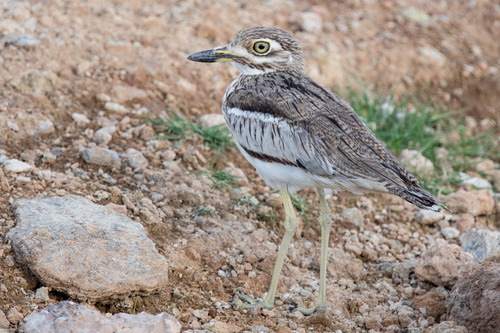
Water Thick-knee
Burhinus vermiculatus
With its large, luminous yellow eyes and haunting nocturnal whistle, the Water Thick-knee is the ultimate master of camouflage along Africa's riverbanks.
Quick Identification
Size
38-41 cm (15-16 in) in length; wingspan of approx. 75-80 cm (30-31 in); weighs 290-440 g (10.2-15.5 oz)
Colors
Cryptic mottled brown and grey upperparts with heavy dark streaks; white underparts with fine streaking; distinctive white wing bar bordered by a black line; large yellow eyes.
Key Features
- Large, striking yellow eyes adapted for night vision
- Prominent white wing bar with a black border across the folded wing
- Thick, knobby yellow-green leg joints
- Heavily streaked brown and grey plumage for camouflage
- Strong, straight bill with a yellow base and black tip
When You’ll See Them
Geographic range
Where Does the Water Thick-knee Live?
Native to the African continent, the Water Thick-knee is a widespread resident throughout much of sub-Saharan Africa. Its core range spans from the southern reaches of South Africa and Namibia, stretching northwards through the Great Rift Valley in East Africa to Ethiopia, and across the tropical belts of West Africa to Senegal. Because it is a non-migratory species, these birds remain in their established territories year-round, provided their water source does not completely disappear.
Basemap © OpenStreetMap contributors
Behavior
The Water Thick-knee is a master of camouflage, often spending the heat of the day standing perfectly still or crouching low among stones and reeds near the water's edge. When threatened, its first instinct is to freeze, relying on its cryptic plumage to blend into the shoreline. It only takes flight as a last resort, revealing a bold wing pattern as it glides low over the water with shallow, stiff wingbeats.
Primarily crepuscular and nocturnal, this bird becomes highly active as dusk falls. It is well-known for its haunting, whistling calls—a series of 'pi-pi-pi-pi-pee-pee-pee' notes—that often ring out across African riverbanks at night. While they are usually found in pairs or small family groups, they are highly territorial during the breeding season and will aggressively defend their nest sites, which are simple scrapes in the ground near water.
EverydayEarth exclusive
Camera Tips
To capture the Water Thick-knee on camera, placement is everything. Position your AI-powered camera within 5-10 feet of a shoreline or a known watering hole. Because these birds have a habit of 'freezing' when they sense movement, set your camera's trigger sensitivity to high to ensure you catch them as they first arrive or begin to forage. A low mounting height—about 12 to 18 inches off the ground—is ideal for capturing their unique profile and those famous 'thick' knees at eye level.
Since this species is most active during the 'blue hour' of dawn and dusk and well into the night, prioritize a camera with high-quality infrared (IR) or 'no-glow' night vision. Standard white flash can startle them and cause them to flee the area for several nights. If you are using an EverydayEarth AI camera, look for recordings between 6 PM and 9 PM when they are most likely to be vocalizing and moving along the mudflats.
While you shouldn't bait these birds directly, you can encourage them to frequent a specific spot by maintaining a clear, flat area of sand or short grass near a water feature. They prefer open visibility so they can spot predators. In suburban settings, a quiet garden pond with a gently sloping beach area is a magnet for them. During the breeding season (variable by region), keep an eye out for pairs performing their bowing displays, but be careful not to disturb potential ground nests.
Similar Species
Species that look similar or are commonly confused with Water Thick-knee.
Frequently Asked Questions
Record Water Thick-knee at your habitat
Connect a camera to start building your own species record — AI identifies every visitor automatically.