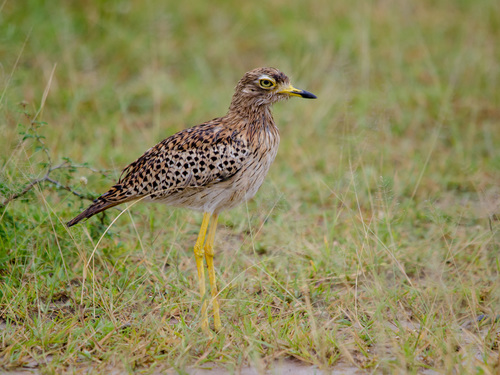
Spotted Thick-knee
Burhinus capensis
A master of camouflage with piercing yellow eyes, the Spotted Thick-knee is the ultimate nocturnal neighbor. Often hidden in plain sight during the day, this 'dikkop' comes alive at night with haunting whistles and expert hunting skills.
Quick Identification
Size
Length: 34–45 cm (13–18 in); Wingspan: 75–85 cm (30–33 in); Weight: 350–600 g (12–21 oz)
Colors
Upperparts are tawny-brown with heavy dark brown spotting and streaking; underparts are off-white to pale buff; large yellow eyes and yellow-green legs.
Key Features
- Large, bulging yellow eyes designed for nocturnal vision
- Thick, prominent 'knobby' joints on the legs
- Intricately spotted brown and cream camouflage plumage
- Often seen standing perfectly still in a 'frozen' posture
When You’ll See Them
Sightings on EverydayEarth
Jul 3, 2026
Under the cover of night, a White Rhinoceros is resting on the ground in the background. In the foreground, two ground-dwelling birds, identified as Spotted Thick-knees, are tucked in and sleeping in the open space.
Jul 2, 2026
A quiet nighttime scene shows a large White Rhinoceros resting on the ground. Two Spotted Thick-knees are perched nearby in the open clearing, occasionally turning their heads as they watch their surroundings.
Jun 25, 2026
Two Spotted Thick-knees are resting on the ground at night. One bird remains still and tucked in, while the other is more active, turning its head and adjusting its posture.
Jun 24, 2026
A Spotted Thick-knee is crouched in the center of the clearing, remaining mostly still while occasionally turning its head to scan the area. To the far right, a large mammal is resting, with only its grey flank and a flickering tail visible at the edge of the camera's view.
Jun 24, 2026
Under the cover of night, a White Rhinoceros is resting on the ground in the lower right portion of the frame. In the center of the clearing, a Spotted Thick-knee stands perfectly still, its large eyes occasionally reflecting the infrared light as it monitors the environment.
Jun 23, 2026
Under the cover of night, two White Rhinoceroses are seen resting quietly on the ground. Their heavy bodies and thick, folded skin are illuminated by the infrared light. In the center of the clearing, a Spotted Thick-knee remains perfectly still, its camouflaged feathers helping it blend into the environment as it rests on the earth.
Geographic range
Where Does the Spotted Thick-knee Live?
Native to the African continent, the Spotted Thick-knee thrives across a vast territory in sub-Saharan Africa. Its core range spans from the southern tip of South Africa through the savannas of Botswana, Namibia, and Zimbabwe, extending northward into East African nations like Kenya and Tanzania, and reaching across to parts of West Africa. This adaptable bird is a permanent resident in most of its range, successfully transitioning from wild bushveld to the manicured lawns of suburban neighborhoods.
Basemap © OpenStreetMap contributors
Behavior
The Spotted Thick-knee is a master of stealth and camouflage. During the day, it remains largely inactive, roosting in the shade of bushes or in long grass where its spotted plumage makes it nearly invisible to predators. If approached, it typically relies on its camouflage by crouching low and staying perfectly still, only taking flight as a last resort. When it does fly, it remains low to the ground with slow, deliberate wingbeats.
As dusk falls, the bird becomes much more active and vocal. It is well-known for its loud, whistling 'twee-ti-ti-ti' calls that carry long distances in the night air. While they are usually found in pairs or small groups, they are highly territorial during the breeding season. They are also remarkably bold in suburban environments, often choosing to nest on flat roofs or in quiet corners of gardens where they have become accustomed to human presence.
EverydayEarth exclusive
Camera Tips
To capture high-quality footage of the Spotted Thick-knee, your camera should be positioned low to the ground—no higher than 30 to 50 centimeters. Since these are ground-dwelling birds that rarely perch, a low-angle shot provides the best perspective of their 'thick' knee joints and striking yellow eyes. Place your camera near the edges of open lawn areas or clearings where they are known to forage or roost during the day. Look for sandy patches where you might find their distinctive three-toed tracks.
Lighting and trigger settings are critical for this nocturnal specialist. Ensure your camera uses a high-quality infrared (IR) flash to avoid scaring the birds with bright white light, which can cause them to flush. Set the trigger sensitivity to 'High' because their 'frozen' behavior and slow, stalking movements might not trigger less sensitive sensors. If your camera supports video, use a 20-30 second clip duration to capture their unique bobbing head motion and high-stepping walking gait.
While you should avoid using food bait that might attract predators like feral cats, you can attract Spotted Thick-knees by encouraging their natural prey. Positioning your camera near a low-wattage garden light that attracts nocturnal insects like moths and beetles creates a natural 'buffet' for the birds. During the breeding season (usually spring and summer), they may nest in suburban gardens. If you find a nest—which is simply a scrape in the ground—place the camera at least 3-5 meters away to avoid disturbing the parents, who can be very protective and may perform 'broken-wing' distraction displays.
Similar Species
Species that look similar or are commonly confused with Spotted Thick-knee.
Water Thick-knee
Preferentially found near rivers and lakes; features a prominent horizontal grey-and-white wing bar which the Spotted Thick-knee lacks.
Senegal Thick-knee
Smaller with less distinct spotting on the upperparts and a more prominent pale band on the wing; typically found in drier regions of North and West Africa.
Frequently Asked Questions
Record Spotted Thick-knee at your habitat
Connect a camera to start building your own species record — AI identifies every visitor automatically.