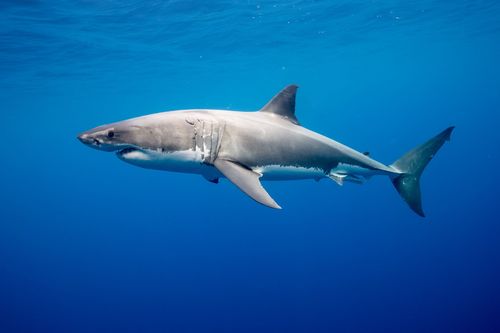
Great White Shark
Carcharodon carcharias
The ocean's most iconic apex predator, the Great White Shark is a masterpiece of evolution and intelligence. From its massive serrated teeth to its surprising warm-blooded biology, this giant of the deep is a vital guardian of marine ecosystems.
Quick Identification
Size
4.5 to 6.4 meters (15 to 21 feet) in length; weight typically ranges from 680 to 2,268 kg (1,500 to 5,000 lbs)
Colors
Slate-gray to bluish upperside with a starkly contrasting white underside; dark, soulful eyes that appear black
Key Features
- Large, triangular, serrated teeth
- Deeply notched tail fin of nearly equal lobe size
- Robust, torpedo-shaped body
- Prominent triangular dorsal fin
- White underbelly with a jagged 'waterline' boundary
When You’ll See Them
Geographic range
Where Does the Great White Shark Live?
Great White Sharks are truly global citizens of the ocean, found in temperate and subtropical waters across every major basin. They are most commonly encountered along the coasts of South Africa, Australia, and New Zealand, but they also maintain significant populations along the Pacific and Atlantic coasts of North America. From the rugged shores of Guadalupe Island in Mexico to the chilly waters of the Mediterranean, these migratory giants follow deep-sea 'highways' to travel thousands of miles between feeding and breeding grounds.
Basemap © OpenStreetMap contributors
Behavior
Great White Sharks are highly sophisticated apex predators that exhibit much more complex social behaviors than previously thought. While often seen as solitary hunters, they establish clear social hierarchies based on size, sex, and tenure at specific feeding grounds. They communicate through subtle body language, such as pectoral fin displays and mouth gapes, to avoid unnecessary physical conflict. Their intelligence is most evident in their hunting strategies, which vary based on the prey; for instance, they utilize high-speed vertical 'breaching' to surprise seals at the surface.
Contrary to their 'man-eater' reputation, humans are not a natural part of their diet. Most interactions with humans are 'investigatory bites,' where the shark uses its sensitive mouth to identify an object. They are partially endothermic (warm-blooded), allowing them to maintain a body temperature higher than the surrounding water, which gives them a massive energy advantage when hunting in cold, nutrient-rich currents.
EverydayEarth exclusive
Camera Tips
Capturing a Great White Shark on camera requires specialized equipment and a different approach than typical backyard wildlife. For those lucky enough to live near the coast, the most effective tool is a Baited Remote Underwater Video (BRUV) system. This consists of a waterproof camera housing mounted to a weighted frame with a bait bag attached to an extended arm. The scent of fish oil or 'chum' will draw the shark into the camera's field of view without the need for a human diver in the water.
If you are filming from a pier, boat, or shoreline, use a high-quality circular polarizing filter to cut through the surface glare and reflections. This allows the camera to see 'into' the water, revealing the dark silhouette of the shark as it passes underneath. For trail cameras used near the shore, look for high-vantage points overlooking known seal colonies, as sharks will often cruise the 'drop-off' zones where the water suddenly deepens.
Lighting is your biggest challenge underwater. If using a submersible camera, aim for shallow water (less than 5 meters) during the middle of the day to maximize natural light penetration. If you are using a triggered system, set your camera to a fast shutter speed (at least 1/500th of a second) to freeze the motion of a shark, as their movements are deceptively fast. Always ensure your gear is thoroughly rinsed with fresh water after salt-water deployment to prevent corrosion.
Similar Species
Species that look similar or are commonly confused with Great White Shark.
Frequently Asked Questions
Record Great White Shark at your habitat
Connect a camera to start building your own species record — AI identifies every visitor automatically.