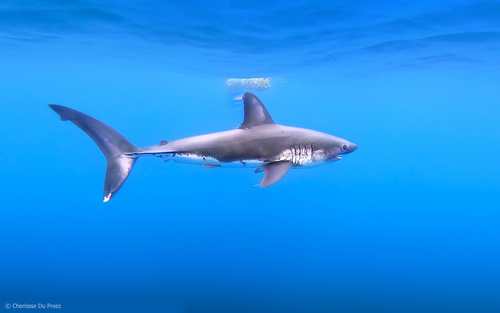
Salmon Shark
Lamna ditropis
The ultimate cold-water athlete, the Salmon Shark is a warm-blooded marvel of the North Pacific. Often called the 'Great White of the North,' this spotted predator is the shadow following the great salmon runs.
Quick Identification
Size
2.0-3.0 meters (6.6-10 feet) in length; weight typically ranges from 150-220 kg (330-485 lbs).
Colors
Dark gray to charcoal dorsal (top) side with a white underside; the belly is uniquely characterized by irregular dark blotches or spots.
Key Features
- Heavy, spindle-shaped thunniform body
- Dark mottling or spots on a white belly
- Large, black eyes and a short, conical snout
- High-contrast white patches on the base of the pectoral fins
- Crescent-shaped (homocercal) tail fin
When You’ll See Them
Behavior
The Salmon Shark is a powerhouse of the North Pacific, often mistaken for a juvenile Great White due to its similar profile. However, it possesses a remarkable biological adaptation called homeothermy, which allows it to maintain a stomach temperature significantly higher than the surrounding frigid water. This elevated metabolism makes them incredibly fast and agile hunters, capable of pursuing high-speed prey that would outpace more cold-blooded competitors.
While generally solitary, Salmon Sharks are known to congregate in massive numbers during annual salmon migrations. They are highly migratory, with some individuals traveling thousands of miles between Alaskan waters and the subtropics. Despite their intimidating appearance and apex predator status, they are not considered a major threat to humans, though their sheer size and speed mean they should be observed with caution.
EverydayEarth exclusive
Camera Tips
Capturing a Salmon Shark on camera requires specialized underwater equipment, as they are rarely seen from the surface except for occasional finning. If you are using a stationary underwater trail camera or an ROV, focus your efforts on coastal 'bottlenecks' such as estuaries or narrow channels where salmon congregate before heading upstream. These are the primary hunting grounds where sharks are most likely to pass within frame.
Lighting is your biggest challenge in the murky, plankton-rich waters of the North Pacific. Use cameras with high dynamic range (HDR) to handle the silhouette effect of the sun against the water's surface. Because Salmon Sharks are 'thunniform' swimmers—meaning they use high-speed tail oscillations—set your camera to at least 60 frames per second (fps). This ensures that the shark's movement remains fluid and sharp rather than a motion-blurred streak.
Be mindful of the shark's electroreception. Like all sharks, they are sensitive to electromagnetic fields emitted by electronics. If your camera housing is metallic or has an exposed battery tether, a curious shark might 'test-bite' the equipment. Using a stealthy, non-reflective housing and minimizing dangling cables will help prevent your gear from becoming a chew toy. If legal in your area, a perforated canister of fish oil (chum) can be secured near the camera to draw them into the field of view.
Similar Species
Species that look similar or are commonly confused with Salmon Shark.
Frequently Asked Questions
Record Salmon Shark at your habitat
Connect a camera to start building your own species record — AI identifies every visitor automatically.