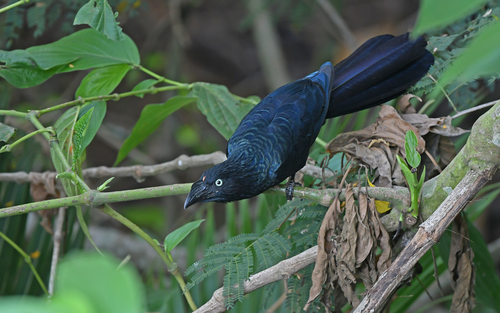
Greater Ani
Crotophaga major
A social marvel of the tropical wetlands, the Greater Ani stands out with its shimmering blue-black feathers and piercing white eyes. Often found in noisy family groups, these communal nesters bring a prehistoric charm to the riverbanks of South America.
Quick Identification
Size
Length of 43-51 cm (17-20 in); Weight of approximately 170 g (6 oz)
Colors
Glossy blue-black plumage with strong iridescent turquoise and violet highlights; distinct pale yellow to white iris
Key Features
- Massive deep bill with a smooth, high ridge on the upper mandible
- Striking white or pale yellow iris contrasting with dark plumage
- Very long, broad, rounded tail
- Iridescent blue and green sheen on wings and back
When You’ll See Them
Geographic range
Where Does the Greater Ani Live?
Native to the tropical heart of South America, the Greater Ani is a quintessential bird of the continent's massive river systems. Its range begins in eastern Panama and stretches across the northern countries of Colombia, Venezuela, and the Guianas, extending deep into the Amazon Basin of Brazil, Peru, and Bolivia. It reaches its southern limit in the wetlands of northern Argentina and Paraguay, consistently sticking to lowland areas where water is abundant.
Basemap © OpenStreetMap contributors
Behavior
The Greater Ani is an exceptionally social bird, rarely seen alone. They move in boisterous groups of 5 to 15 individuals, often described as 'floating' through the canopy with a distinctive flap-and-glide flight. Unlike many birds, they practice communal nesting where several pairs contribute eggs to a single, large stick nest and share incubation and chick-rearing duties. This cooperative lifestyle extends to their vocalizations; they are incredibly noisy, producing a range of gurgling, boiling, and croaking sounds that can be heard from a distance.
In the presence of humans, they are relatively wary compared to their smaller cousins (the Smooth-billed Ani), preferring to stay near the safety of water-fringed vegetation. They spend much of their day foraging in the mid-story of flooded forests or along riverbanks. Their social bonds are reinforced through mutual preening and synchronized movements, making them a fascinating subject for observers interested in avian social dynamics.
EverydayEarth exclusive
Camera Tips
To capture the Greater Ani, location is everything. These birds are almost never found far from water, so focus your camera placement on shoreline 'corridors' where dense vegetation meets a river, lake, or swamp. Look for overhanging branches that serve as regular perches; Greater Anis often use the same paths to move between foraging grounds and communal roosts. Position your camera at a slight upward angle if aiming at these branches, or at chest height if you find a clearing near a marsh where they might drop to the ground for insects.
Because their plumage is highly iridescent, lighting can be your best friend or your worst enemy. Direct midday sun often results in 'blown out' highlights on their shiny feathers. For the best results, set your camera to capture high-resolution photos or video during the 'golden hours' of early morning. This softer light will better reveal the spectacular turquoise and violet sheens that distinguish this species from the more matte-black cuckoos.
Since Greater Anis travel in tight-knit groups, a standard narrow-field trigger might miss the bulk of the action. If your camera allows, use a wide-angle lens setting or a multi-shot burst mode. When one bird appears, several more are likely to follow within seconds. Avoid using heavy lures or baits, as these birds are naturally curious about movement; instead, try placing your camera near a fruiting tree (like Ficus) during the dry season when they supplement their insect diet with fruit.
Similar Species
Species that look similar or are commonly confused with Greater Ani.
Frequently Asked Questions
Record Greater Ani at your habitat
Connect a camera to start building your own species record — AI identifies every visitor automatically.