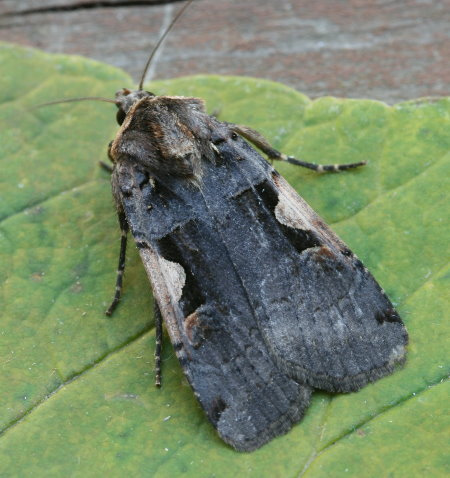
Greater Black-letter Dart
Xestia dolosa
A master of nocturnal camouflage, the Greater Black-letter Dart is a common but often overlooked gem of the North American night. With its subtle earthy tones and distinctive 'letter' wing markings, it is a favorite for backyard naturalists exploring the world of owlet moths.
Quick Identification
Size
Wingspan of 35-45 mm (1.4-1.8 inches); body length approximately 20-25 mm
Colors
Mottled dark brown to grayish-brown forewings; distinct black square or wedge-shaped markings near the wing center; pale, smoky gray hindwings
Key Features
- Prominent black 'wedge' or 'letter' mark on the forewing
- Two-toned brown coloration with subtle purple or red tints
- Stout, hairy thorax typical of owlet moths
- Jagged dark subterminal line across the wing
When You’ll See Them
Geographic range
Where Does the Greater Black-letter Dart Live?
Native to the North American continent, the Greater Black-letter Dart occupies a vast territory stretching from the Atlantic coast to the Great Plains. Its core range extends from the Canadian maritime provinces like New Brunswick and Prince Edward Island down through the eastern United States to Florida, reaching as far west as Texas, South Dakota, and Manitoba. It is a highly adaptable species that thrives in both the humid subtropical south and the temperate northern forests.
Basemap © OpenStreetMap contributors
Behavior
The Greater Black-letter Dart is a nocturnal 'owlet' moth that spends much of its life cycle as a larva known as the woodland spotted cutworm. During the day, adults are masters of camouflage, resting motionlessly against tree bark or within deep leaf litter where their earthy tones blend perfectly. They become active shortly after dusk, taking flight to seek out nectar sources, mates, and suitable locations for egg-laying.
Unlike many moth species that have a single short emergence window, this species is known for having two distinct broods in much of its range, resulting in 'flight peaks' in early summer and again in late summer. They are highly sensitive to light and pheromones, making them a common sight around porch lights or garden lanterns. While the larvae can be garden pests, the adults are vital nocturnal pollinators for various native flora.
EverydayEarth exclusive
Camera Tips
To capture high-quality images of the Greater Black-letter Dart, your most effective strategy is to set up a 'moth wall.' Hang a white cotton sheet vertically and illuminate it with a UV (blacklight) or mercury vapor lamp. Position your AI-powered camera on a tripod approximately 2 to 3 feet from the sheet, ensuring the focus is set for macro or close-up distances. Because these moths are attracted to specific ultraviolet wavelengths, this method will yield far better results than standard white light alone.
For a more natural 'trail' setup, use a technique called 'sugaring.' Create a thick, pungent bait by mixing overripe bananas, molasses, brown sugar, and a splash of fermented beer. Paint this mixture in a square patch on the rough bark of a deciduous tree at eye level. Mount your camera on an adjacent tree or a stake about 4 feet away, angled directly at the bait. The Greater Black-letter Dart is particularly fond of fermented sweets and will often linger on the bait for several minutes, allowing for clear, multi-angle captures.
Since this species is strictly nocturnal, ensure your camera's infrared (IR) flash is optimized. High-resolution settings are critical here, as the identifying 'black-letter' mark on the wing can be subtle in low-light grayscale images. If your camera allows for trigger sensitivity adjustments, set it to 'High' to capture the quick fluttering movements as they land. Late May and late August are the best times to deploy your gear to catch the peak of the two annual generations.
Similar Species
Species that look similar or are commonly confused with Greater Black-letter Dart.
Frequently Asked Questions
Record Greater Black-letter Dart at your habitat
Connect a camera to start building your own species record — AI identifies every visitor automatically.