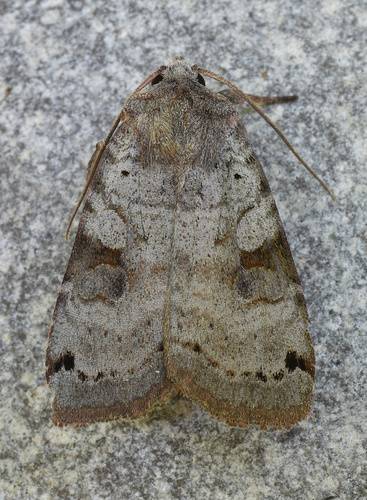
Smith's Dart
Xestia smithii
A warm-toned wonder of the northern night, Smith's Dart is a master of camouflage. This cinnamon-colored moth is a staple of North American woodlands and a frequent visitor to late-summer garden lights.
Quick Identification
Size
Wingspan of 30–40 mm (1.2–1.6 inches)
Colors
Forewings are typically reddish-brown, cinnamon, or clay-colored; hindwings are a uniform smoky gray-brown.
Key Features
- Reddish-brown to cinnamon forewings
- Distinctive black spots (orbicular and reniform) often outlined in pale scales
- Subterminal line marked by small dark wedges
- Small, robust body characteristic of the owlet moth family
When You’ll See Them
Geographic range
Where Does the Smith's Dart Live?
Smith's Dart is a native North American species with a wide distribution across the northern half of the continent. Its core range spans from the Atlantic coast of Newfoundland and New England, across the Great Lakes region, and through the Canadian provinces to Alaska. It also extends southward into the United States along higher elevations in the Appalachian and Rocky Mountains, where cooler temperatures mimic its northern strongholds.
Basemap © OpenStreetMap contributors
Behavior
Smith's Dart is a nocturnal moth that remains largely hidden during daylight hours. They use their cryptic coloration to blend perfectly with dead leaves, bark, and forest floor debris to avoid predation. When darkness falls, they become active flyers, searching for nectar sources and mates. Unlike some more frantic insect species, Smith's Darts are often seen resting calmly near light sources or on bait stations once they have found a food source.
As members of the Noctuidae family, they exhibit typical 'owlet moth' behaviors, including a strong attraction to artificial light (phototaxis). They are solitary creatures and do not form colonies. While they are common in many northern backyards, they are entirely harmless to humans and do not cause significant damage to garden plants, as their larvae prefer wild forest undergrowth.
EverydayEarth exclusive
Camera Tips
To capture high-quality images of Smith's Dart, position your camera near a 'sugar baiting' station. Mix overripe bananas, brown sugar, and a splash of beer or molasses into a thick paste and paint it onto the trunk of a tree roughly 4-5 feet off the ground. Set your camera on a tripod or mount it to a nearby branch, focusing specifically on the baited area. Because these moths are small, a macro lens or a camera with a close-up focus capability (1-3 feet) is essential for capturing the intricate wing patterns.
Since Smith's Dart is strictly nocturnal, utilize a 'no-glow' or 'black' infrared flash to illuminate the subject without washing out the colors. High-resolution settings are vital here; the distinguishing features of the Xestia genus are often found in the subtle outlines of the wing spots. If your camera allows, use a 'photo + video' mode so you can see the moth's feeding behavior and wing positioning, which helps in differentiating it from similar-looking 'dart' species.
Seasonality is key for this species. In most northern regions, the adults only fly for a few weeks between late July and early September. Check your local weather and aim for warm, humid nights with little wind, as these are the peak activity periods for Smith's Dart. Ensure your PIR (motion) sensor sensitivity is set to high, as moths have very low thermal signatures and may not trigger sensors designed for larger mammals unless they fly very close to the lens.
Similar Species
Species that look similar or are commonly confused with Smith's Dart.
Frequently Asked Questions
Record Smith's Dart at your habitat
Connect a camera to start building your own species record — AI identifies every visitor automatically.