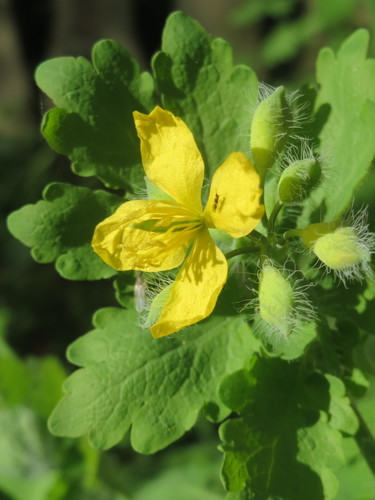
Greater celandine
Chelidonium majus
A resilient member of the poppy family, Greater celandine illuminates shady garden corners with its golden blossoms and fascinating medicinal history.
Quick Identification
Size
30–120 cm (12–47 inches) tall with a spread of 30–60 cm (12–24 inches)
Colors
Bright yellow flowers; blue-green glaucous leaf undersides; vibrant green foliage
Key Features
- Four-petaled yellow flowers in loose clusters
- Deeply lobed, scalloped blue-green leaves
- Stems produce a thick orange-yellow latex when broken
- Slender, upright green seed capsules
When You’ll See Them
Behavior
Greater celandine is a hardy perennial plant that belongs to the poppy family. Unlike many other garden plants, it has a unique 'behavioral' relationship with local insect populations. Its seeds are equipped with a fatty appendage called an elaiosome, which is irresistible to ants. The ants carry the seeds back to their colonies, eat the fatty bit, and leave the seed to germinate in nutrient-rich soil, a process known as myrmecochory.
The plant is also famous for its chemical defense mechanism. When a stem or leaf is broken, it immediately exudes a bright orange, caustic sap. This sap contains alkaloids that protect the plant from herbivores and have been used in traditional folk medicine for centuries to treat skin ailments, though it is considered toxic if ingested and can irritate sensitive skin.
EverydayEarth exclusive
Camera Tips
To capture the beauty of Greater celandine on a backyard camera, you should focus on its growth cycle and the pollinators it attracts. Set your camera on a tripod at a low height—about 18 to 24 inches from the ground—and angle it slightly downward to capture the contrast between the yellow flowers and the scalloped green leaves. Because plants don't move, this is the perfect opportunity to use 'Time-Lapse' mode. Set your camera to take a photo every 30 minutes during the spring to watch the stalks rise and the buds unfurl into bright yellow blooms.
If you are looking to capture wildlife interaction, focus your lens closely on a healthy cluster of flowers. Greater celandine is a favorite of small hoverflies, solitary bees, and occasionally early-season butterflies. Use a high-shutter speed if your camera allows, as these insects move quickly. To get the best lighting, avoid the harsh midday sun which can 'blow out' the bright yellow petals; instead, aim for the soft, diffused light of early morning or late afternoon. This will highlight the delicate textures and the fine hairs on the plant's stems.
For those interested in the plant's unique seed dispersal, place a camera near the base of the plant during late summer when the seed capsules begin to open. You might be able to record ants scurrying away with the seeds. Since this plant thrives in the shade, ensure your camera's ISO settings are adjusted for lower light conditions to prevent grainy footage. If using a motion-activated camera, be aware that wind can cause frequent triggers with the large, lobed leaves, so adjusting the sensitivity to 'Low' or using a dedicated time-lapse setting is recommended.
Similar Species
Species that look similar or are commonly confused with Greater celandine.
Frequently Asked Questions
Record Greater celandine at your habitat
Connect a camera to start building your own species record — AI identifies every visitor automatically.