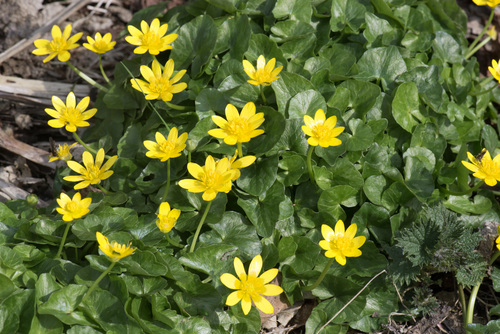
lesser celandine
Ficaria verna
A cheerful herald of the coming warmth, lesser celandine blankets the damp earth in a sea of glossy, star-shaped yellow blooms. This resilient perennial is one of the first to wake each year, signaling the true start of spring.
Quick Identification
Size
Height: 5-25 cm (2-10 inches); Flower diameter: 2-6 cm (0.8-2.4 inches)
Colors
Glossy butter-yellow flowers; dark green heart-shaped leaves, sometimes with silvery-white or purple-brown variegation
Key Features
- 8-12 glossy yellow petals per flower
- Dark green, fleshy, heart-shaped leaves
- Low-growing, carpet-forming growth habit
- Cream-colored bulbils located in the leaf axils
When You’ll See Them
Behavior
Lesser celandine is a true spring ephemeral, acting as a "harbinger of spring" by emerging in late winter when most other plants are still dormant. It grows in dense, mat-like colonies that can quickly blanket a forest floor or garden bed. This strategy allows it to capture maximum sunlight before the trees above it develop their leaves, providing an early and vital nectar source for the first emerging bees of the season.
The plant exhibits "nyctinasty," meaning its flowers respond to light and temperature; they open wide in the bright midday sun and close tightly at night or during heavy rain to protect their pollen. While its bright yellow blooms are a welcome sight in its native Europe, in North America it is treated as a highly aggressive invader that outcompetes native wildflowers by forming thick subterranean mats of tubers that prevent other seeds from germinating.
EverydayEarth exclusive
Camera Tips
To capture the best images of lesser celandine, you need to get low. Because this plant rarely grows taller than a few inches, standard trail camera mounts on trees will likely miss the action or result in a distorted downward angle. Use a ground-level stake or a small flexible tripod to position your camera just 3-5 inches off the forest floor. Angle the lens slightly upward to catch the underside of the petals and the structure of the heart-shaped leaves.
Lighting is the biggest challenge when photographing this species. The petals have a unique, wax-like coating that makes them incredibly glossy and reflective. In direct midday sun, this often results in "blown-out" highlights where the yellow looks like a featureless white blob. To get the best results, use a camera with adjustable exposure settings and dial it down by -0.7 or -1.0. Alternatively, aim for the "golden hour" shortly after sunrise or before sunset when the light is softer and brings out the rich, buttery texture of the flowers.
Since plants don't move fast enough to trigger motion sensors, the "Time Lapse" mode is your most powerful tool. Set your camera to take a photo every 15 minutes between 8 AM and 6 PM. When you stitch these together, you will see a fascinating dance as the flowers unfurl to greet the sun and track its movement across the sky before closing up for the evening. If you are in a region where this plant is invasive, this time-lapse data can also help you track its rate of spread across your property, providing valuable data for local conservation efforts.
Similar Species
Species that look similar or are commonly confused with lesser celandine.
Frequently Asked Questions
Record lesser celandine at your habitat
Connect a camera to start building your own species record — AI identifies every visitor automatically.