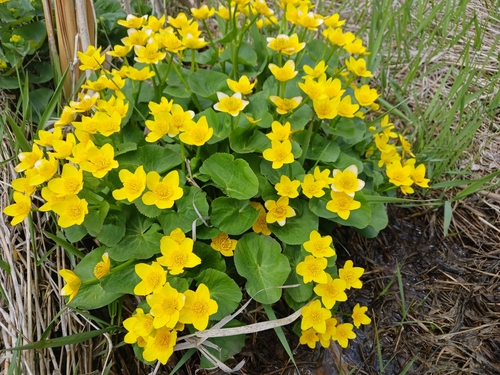
marsh marigold
Caltha palustris
Glowing like nature's gold in the damp spring mud, the marsh marigold is a resilient herald of the changing seasons. These moisture-loving perennials brighten up swampy backyard corners with their brilliant yellow blooms and glossy, heart-shaped leaves.
Quick Identification
Size
Height: 20–60 cm (8–24 inches); Spread: 30–45 cm (12–18 inches)
Colors
Brilliant waxy yellow flowers; deep, glossy forest-green foliage; no color distinction between sexes as they are hermaphroditic
Key Features
- 5 to 9 bright yellow waxy sepals (appearing as petals)
- Heart or kidney-shaped glossy dark green leaves
- Hollow, succulent-like stems that are often furrowed
- Grows in distinct rounded clumps in saturated soils
When You’ll See Them
Behavior
Marsh marigolds are resilient heralds of spring, often pushing through the mud while ice still lingers in the shade. These plants exhibit a fascinating behavior called heliotropism, where their flower heads subtly tilt throughout the day to track the sun. This serves a dual purpose: it maximizes the light available for photosynthesis and creates a warm microclimate inside the flower cup. This 'thermal reward' attracts early-season insects like hoverflies and small bees that are looking for a place to warm up while they feed.
In terms of social interaction with their environment, they are incredibly peaceful neighbors but fierce competitors for space in wet ditches. While they appear delicate, they produce a caustic chemical called protoanemonin to protect themselves. This makes them largely 'deer-proof' and 'rabbit-proof,' as most herbivores find the taste acrid and irritating. For humans, they are a sign of a healthy wetland; where you find marsh marigolds, you likely have a clean, consistent water source nearby.
EverydayEarth exclusive
Camera Tips
Capturing the marsh marigold requires a different strategy than tracking mobile wildlife. Because these plants thrive in boggy, saturated soil, the first challenge is stability. If you are using a tripod for a trail camera or a DSLR, place a wide, flat board or a large tile on the mud to prevent your gear from slowly sinking over time. A low-angle shot is the most rewarding; positioning the camera just a few inches above the water line allows you to capture the stunning reflection of the yellow sepals in the dark marsh water.
Time-lapse photography is the best way to utilize an AI-powered camera with this species. Set your interval to one frame every 10 to 15 minutes between 7 AM and 11 AM. This allows you to document the dramatic 'waking up' process as the flowers unfurl their waxy sepals to meet the morning sun. Be mindful of exposure settings; the brilliant yellow of the marsh marigold is highly reflective and can easily 'blow out' and lose detail in direct midday sun. To avoid this, set your camera to capture during the 'golden hour' or on slightly overcast days, which provides a natural softbox effect that saturates the greens and yellows perfectly.
To capture the 'action' associated with this plant, focus your lens on the center of a healthy cluster and use a high-speed trigger or video mode. Marsh marigolds are one of the first nectar sources for early-season pollinators. By keeping the camera still and focused on a single bloom, you can record the arrival of bee flies, hoverflies, and even the occasional early butterfly. Finally, because these plants live in high-humidity environments, ensure your camera housing is well-sealed and consider using a small packet of silica gel inside the case to prevent lens fogging during the damp spring mornings.
Similar Species
Species that look similar or are commonly confused with marsh marigold.
Frequently Asked Questions
Record marsh marigold at your habitat
Connect a camera to start building your own species record — AI identifies every visitor automatically.