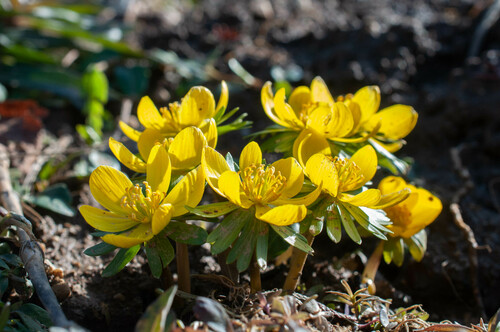
Winter Aconite
Eranthis hyemalis
The brave golden herald of the late winter garden, Winter Aconite defies the frost to carpet the forest floor in brilliant yellow. It is one of the first signs of life to emerge each year, often blooming right through a blanket of snow.
Quick Identification
Size
5-15 cm (2-6 inches) in height; flowers are roughly 2-3 cm (0.8-1.2 inches) in diameter
Colors
Brilliant butter-yellow petals with a prominent 'collar' or ruff of bright green leaf-like bracts directly below the bloom
Key Features
- Cup-shaped bright yellow flowers
- Distinctive ruff of divided green bracts encircling the flower base
- Low-growing habit, often appearing in dense carpets
- Blooms extremely early, often through melting snow
When You’ll See Them
Behavior
Winter Aconite is one of the most resilient harbingers of spring, often pushing its way through frozen ground or light snow cover as early as January or February. These plants are heliophilic, meaning their blossoms are highly sensitive to sunlight. On bright, sunny days, the flowers open wide to attract early-emerging pollinators like honeybees; however, they remain tightly closed during overcast weather and at night to protect their delicate reproductive organs from the cold and moisture.
As ephemeral perennials, they have a very short above-ground life cycle. After flowering, the plant focuses on seed production and energy storage in its underground tubers. By late spring, the foliage withers away completely, leaving the plant dormant underground until the following winter. They are known for their ability to naturalize, slowly spreading across garden beds or woodland floors to create stunning 'golden carpets' over several years.
EverydayEarth exclusive
Camera Tips
To capture the true magic of Winter Aconite, you need to get low. These plants rarely exceed six inches in height, so mount your camera on a ground-level spike or a very low tripod. A 'worm’s-eye view' looking slightly upward at the yellow blooms against a backdrop of snow or dark leaf litter creates a much more dramatic image than a top-down shot. Ensure your camera is angled at about 10-20 degrees to capture the detail of the green ruff beneath the flower.
Because Winter Aconite reacts to the sun, they are the perfect subject for a time-lapse project. Set your AI-powered camera to take a frame every 5 to 10 minutes starting an hour before sunrise and ending an hour after sunset. This will capture the 'waking up' process as the petals unfurl in response to the light and heat. Make sure your camera is secured firmly, as any shifting due to freezing and thawing ground can ruin the time-lapse sequence.
Exposure can be tricky with these plants because the bright yellow petals can 'blow out' and lose detail, especially if there is reflective white snow nearby. If your camera allows for manual settings, underexpose slightly by 0.5 or 1.0 stop to preserve the rich golden texture. If using a trail camera, position it facing North to avoid direct lens flare from the low winter sun, which can cause heavy shadowing and washing out of the delicate yellow hues.
Lastly, pay attention to the soil. Winter Aconite looks best when it isn't splattered with mud. If you are expecting heavy rain before your shoot, a light mulching of bark or leaf litter around the base of the plant can prevent dirt from splashing onto the petals, keeping your shots clean and professional. Since they bloom when few insects are active, keep an eye out for the occasional early bee—capturing a pollinator on such an early flower is a rare and rewarding shot.
Similar Species
Species that look similar or are commonly confused with Winter Aconite.
Lesser Celandine
Lesser Celandine has heart-shaped basal leaves and lacks the green ruff directly under the flower head.
Wood Anemone
Wood Anemone has similar leaf structures but produces white or pinkish flowers and typically blooms a few weeks later.
Yellow Anemone
Also known as Anemone ranunculoides, it has more petals (usually 5) and lacks the tight green collar of the Aconite.
Frequently Asked Questions
Record Winter Aconite at your habitat
Connect a camera to start building your own species record — AI identifies every visitor automatically.