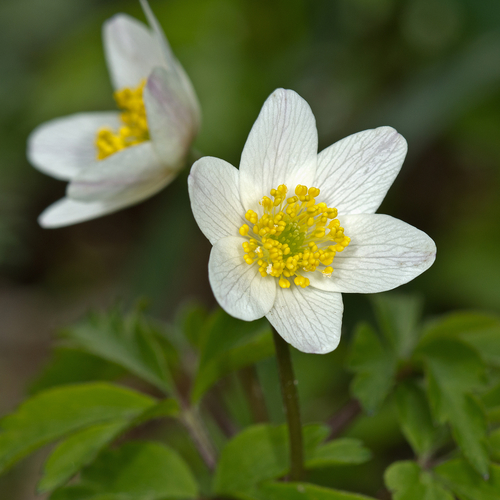
wood anemone
Anemonoides nemorosa
A delicate herald of the changing seasons, the wood anemone carpets forest floors in a sea of white stars before the trees leaf out. These ancient woodland indicators are masters of light, tracking the sun's daily journey to survive the cool spring air.
Quick Identification
Size
Height: 5–15 cm (2–6 in); Flower diameter: 2–4 cm (0.8–1.6 in)
Colors
Brilliant white petals, occasionally flushed with pink or purple on the underside; bright yellow central stamens; deep green foliage.
Key Features
- Usually six to seven white petal-like sepals
- Deeply lobed, palm-like dark green leaves in a whorl of three
- Solitary star-shaped flower on a single reddish-tinted stem
When You’ll See Them
Behavior
The wood anemone is a classic spring ephemeral, a plant that completes its life cycle quickly in the early spring before the canopy of deciduous trees above it fully closes. One of its most fascinating behaviors is heliotropism; the flowers act like tiny satellite dishes, tracking the sun's path across the sky to maximize the warmth hitting their reproductive organs. This movement helps attract the few early-season pollinators, such as hoverflies and bees, that are active in the chilly spring air.
As night falls or if rain begins to move in, the wood anemone exhibits 'sleep movements' known as nyctinasty. The flower heads will droop downward and the sepals will close tightly to protect the delicate pollen from moisture. Because they spread primarily via underground rhizomes rather than seeds—growing at a rate of only about six feet per century—the presence of a large carpet of wood anemones is often used by ecologists as a biological indicator of ancient, undisturbed woodland.
EverydayEarth exclusive
Camera Tips
Capturing the wood anemone on a trail camera requires a departure from standard wildlife settings. Because plants do not move enough to trigger a Passive Infrared (PIR) sensor, you must utilize the 'Time Lapse' or 'Field Scan' mode on your camera. Set the interval to capture a photo every 15 to 30 minutes. This will allow you to create a stunning video sequence showing the flowers opening in the morning, tracking the sun, and bowing their heads as the sun sets.
Placement is critical due to the plant's short stature. Do not mount the camera on a tree trunk at chest height; instead, use a short garden stake or a specialized ground mount to position the camera just 4 to 6 inches above the forest floor. Angle the lens slightly upward to capture the contrast between the white petals and the dark woodland floor, and to ensure the golden stamens are visible in the center of the bloom.
Lighting in a spring forest can be tricky. The high contrast of bright sun through bare branches often results in 'blown out' white flowers. If possible, position your camera so it faces North or South to avoid direct lens flare, or place it in a spot that receives dappled light rather than direct midday sun. The 'Golden Hour'—just after sunrise or before sunset—is the best time for photography, as it often highlights the delicate pink or lilac hues on the undersides of the petals.
Because wood anemones are an early-season species, keep an eye on the weather. A sudden frost can cause the flowers to wilt prematurely. Ensure your camera is out and active as soon as the first green shoots appear in late February or early March. If you are using an AI-powered camera with plant identification features, ensure the lens is clean and free of debris, as the fine details of the leaf shape are often what the AI uses to distinguish this species from similar-looking spring flowers.
Similar Species
Species that look similar or are commonly confused with wood anemone.
Frequently Asked Questions
Record wood anemone at your habitat
Connect a camera to start building your own species record — AI identifies every visitor automatically.