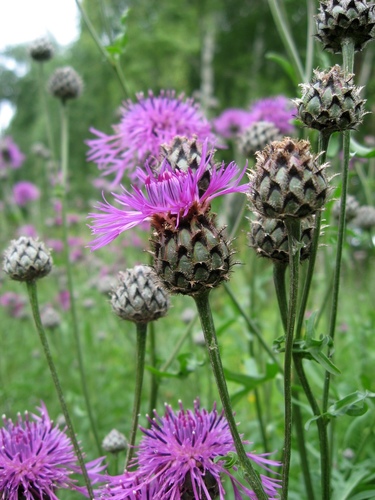
Greater Knapweed
Centaurea scabiosa
The crown jewel of the chalk downs, Greater Knapweed is a purple powerhouse that fuels the insect world. With its striking fringed bracts and architectural beauty, it is the ultimate centerpiece for any wildlife-friendly backyard.
Quick Identification
Size
Grows 45–90 cm (18–35 in) tall, with flower heads 3–5 cm (1.2–2 in) in diameter.
Colors
Bright reddish-purple flower heads with bracts that feature distinctive blackish-brown fringed edges.
Key Features
- Large purple thistle-like flower heads
- Black-fringed (pectinate) bracts below the flower
- Deeply lobed, rough-textured green leaves
- Stiff, upright, grooved stems
- Outer florets significantly larger than inner ones
When You’ll See Them
Geographic range
Where Does the Greater Knapweed Live?
Greater Knapweed is native to Europe and Western Asia, where it is a quintessential feature of the temperate landscape. It is found extensively throughout the United Kingdom, France, and Central Europe, stretching northward into Scandinavia and eastward into the Russian plains. While it is primarily a European specialist of calcareous soils, it has been introduced to parts of North America, where it can now be found in scattered temperate colonies across the United States and Canada. This species is highly sought after in ecological restoration projects across its native range.
Basemap © OpenStreetMap contributors
Behavior
Greater Knapweed is a hardy perennial that acts as a vital anchor for biodiversity in grasslands. Unlike many other wildflowers that may bloom and fade quickly, this species provides a steady, long-lasting source of high-quality nectar from early summer through the first frosts of autumn. It is known as a 'pollinator magnet,' often hosting dozens of different species of bees, butterflies, and beetles in a single day.
As a non-aggressive perennial, it coexists well with other meadow plants, particularly those found on alkaline or chalky soils. While it doesn't move, it exhibits fascinating 'growth behavior' by extending its long taproot deep into the soil to survive droughts. In the garden or wild, it serves as a social hub for insects, making it one of the best plants for wildlife enthusiasts to monitor with high-definition cameras.
EverydayEarth exclusive
Camera Tips
Capturing Greater Knapweed on a trail camera is less about the plant's movement and more about the incredible 'pollinator party' it hosts. To get the best results, mount your camera on a small tripod or stake at the same height as the flower heads, typically 60 to 90 cm (2-3 feet) off the ground. Position the lens about 30 to 50 cm from the bloom to capture the intricate details of the black-fringed bracts and the insects that visit them. Using a camera with a macro or close-up focus setting is essential here.
Because these plants thrive in open, sunny locations, lighting is your biggest ally and your biggest challenge. For the most vivid purple hues, aim to have the sun behind the camera or to the side during the 'Golden Hour' (early morning or late afternoon). Avoid midday sun if possible, as it can wash out the deep magentas of the florets. If your camera has a time-lapse mode, set it to take a photo every 5-10 minutes over several days to witness the slow, beautiful transition from a tight green bud to a glorious purple burst.
Since Greater Knapweed is a magnet for the 'Big Five' of butterflies (Peacocks, Red Admirals, etc.), use high-speed video settings (60fps or higher) if your camera supports it. This will allow you to capture the rapid wing beats and feeding behaviors of visitors in stunning detail. Ensure your camera is secured to a sturdy stake, as knapweed stems are stiff and can trigger motion sensors if they sway in a strong breeze; you may need to clear a small 'buffer zone' of taller grasses immediately around the flower to prevent false triggers.
Finally, remember that the peak activity occurs during July and August. This is when the plant is most attractive to rare insects like the Marbled White butterfly. Check your camera frequently during these months, as the sheer volume of insect activity can quickly fill up an SD card if you are using motion-activated video.
Similar Species
Species that look similar or are commonly confused with Greater Knapweed.
Frequently Asked Questions
Record Greater Knapweed at your habitat
Connect a camera to start building your own species record — AI identifies every visitor automatically.