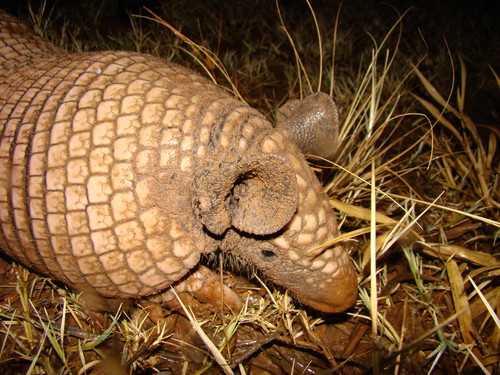
Greater Naked-tailed Armadillo
Cabassous tatouay
The powerhouse of the South American underground, the Greater Naked-tailed Armadillo is a master excavator with a tail unlike any other.
Quick Identification
Size
Total length of 45-70 cm (18-28 in); weight ranges from 3.5-6 kg (7.7-13.2 lbs)
Colors
Dark grayish-brown to dark brown carapace with a paler, pinkish or yellowish underside
Key Features
- Naked, scaleless tail that appears fleshy
- Enormous, sickle-shaped third claw on the forefeet
- Large, funnel-shaped ears
- Wide, blunt snout compared to other armadillos
When You’ll See Them
Geographic range
Where Does the Greater Naked-tailed Armadillo Live?
The Greater Naked-tailed Armadillo is native to the central and southern regions of South America. Its core range encompasses a broad swath of territory including southern Brazil, eastern Paraguay, and Uruguay, extending into the northern provinces of Argentina. While they are widespread within these regions, they are most frequently encountered in the transition zones between dense forests and open pampas or savannas.
Basemap © OpenStreetMap contributors
Behavior
The Greater Naked-tailed Armadillo is a solitary and elusive creature that spends much of its life underground. Unlike many of its cousins, this species is a specialist digger, utilizing its massive foreclaws to tunnel directly into termite mounds or create deep burrows in soft soil. It is primarily nocturnal, emerging under the cover of darkness to forage, making it a rare sight for casual observers.
When moving above ground, they are surprisingly quick but lack the jumping defense mechanism seen in the Nine-banded Armadillo. Instead, if threatened, they rely on their digging prowess to quickly retreat into the earth or wedge themselves into a burrow. They are generally indifferent to human presence unless directly disturbed, focusing almost entirely on their search for subterranean insects.
EverydayEarth exclusive
Camera Tips
Capturing a Greater Naked-tailed Armadillo on camera requires a low-profile strategy. Because these animals are low to the ground and rarely look up, you should mount your AI-powered camera no higher than 12 to 18 inches off the forest floor. Angle the lens slightly downward to capture the detail of their unique naked tail and massive claws, which are key for positive identification against other armadillo species.
Targeting the right location is more effective than using traditional baits. Look for active termite mounds or fresh, circular burrow entrances in loose soil. Placing your camera along a natural 'funnel'—such as a fallen log or a dense hedge line near a forest edge—will increase your chances, as they tend to follow structural pathways while foraging. Unlike some mammals, they aren't particularly attracted to food lures, but fresh soil disturbances often indicate they are nearby.
Since they are strictly nocturnal, ensure your camera has a strong infrared flash that won't spook them. Set your device to take short video clips (10-15 seconds) rather than just stills. This allows you to observe their unique 'heavy-footed' walking gait and powerful digging behavior. High-sensitivity PIR settings are recommended, as their armor can sometimes insulate their body heat, making them slightly harder for some thermal sensors to trigger compared to furry mammals.
Similar Species
Species that look similar or are commonly confused with Greater Naked-tailed Armadillo.
Frequently Asked Questions
Record Greater Naked-tailed Armadillo at your habitat
Connect a camera to start building your own species record — AI identifies every visitor automatically.