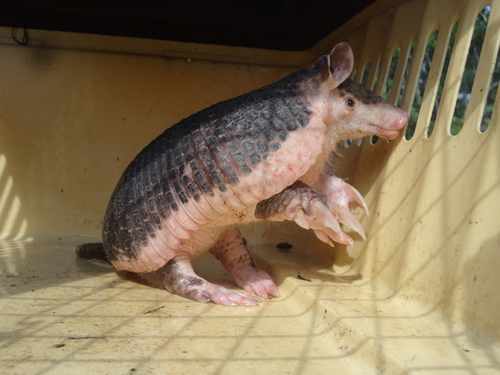
Southern Naked-tailed Armadillo
Cabassous unicinctus
Meet the armored architect of the South American undergrowth. With its specialized naked tail and massive digging claws, this elusive mammal is a master of the subterranean world.
Quick Identification
Size
Head-body length of 30–49 cm (12–19 in) with a tail of 10–20 cm (4–8 in); weighs between 2 and 5 kg (4.4–11 lbs).
Colors
Dark grey to brownish-grey carapace; underside skin is typically a yellowish-white or flesh tone.
Key Features
- Completely scale-less, 'naked' tail
- Enormous, sickle-shaped digging claws on front feet
- Broad, shovel-like snout
- 10–13 movable bands on the mid-section carapace
When You’ll See Them
Geographic range
Where Does the Southern Naked-tailed Armadillo Live?
The Southern Naked-tailed Armadillo is a true resident of South America, calling the vast tropical landscapes of the continent home. Its core range stretches across the lush Amazon basin, through the dense forests and open savannas of Brazil, Colombia, Peru, and Venezuela, as well as the Guyanas. While it isn't found in North America, its extensive presence throughout the northern and central parts of South America makes it a quintessential species of the Neotropical lowlands.
Basemap © OpenStreetMap contributors
Behavior
The Southern Naked-tailed Armadillo is a master of the subterranean world, spending the vast majority of its life underground. Unlike many of its cousins, this species is strictly solitary and highly fossorial, meaning it is specialized for digging. It uses its powerful front claws to 'swim' through loose soil or excavate deep tunnels where it hides during the daylight hours to avoid predators and the tropical heat.
At night, these armadillos emerge to forage, though they are rarely seen by humans due to their shy nature and silent movement. They are not known to be territorial in the traditional sense, but they tend to have large home ranges that they navigate using a keen sense of smell. Interestingly, when threatened, they can bury themselves completely within minutes, leaving only their tough carapace exposed to the surface.
EverydayEarth exclusive
Camera Tips
To capture this elusive digger, camera placement must be extremely low—ideally no more than 15–20 centimeters (6–8 inches) off the ground. These armadillos keep their noses to the earth, so a steep downward angle is necessary to get more than just a shot of their armored back. Look for fresh diggings or 'conical' holes in the soil, which indicate recent foraging activity, and aim your camera toward these hotspots.
Because they are strictly nocturnal, ensure your camera has a high-quality infrared (no-glow) flash. Southern Naked-tailed Armadillos can be surprisingly sensitive to the 'red glow' of standard IR LEDs, so a completely invisible flash is preferred to avoid scaring them off before you get a clear sequence. Set your camera to take bursts of 3–5 photos or short 10-second videos, as they can move through the frame quickly while searching for ants.
Traditional food baits like fruit or corn rarely work for this species since they are specialized insectivores. Instead, focus on 'environmental lures.' If you find a large termite mound, position the camera facing a side that shows signs of previous scratching. In backyard settings near forest edges, keeping a patch of mulch or loose, untreated soil can sometimes attract them, as it provides easy digging for grubs and ants.
Check your camera's trigger speed settings. These armadillos are surprisingly fast when they aren't actively digging, often scuttling from one burrow to another. A trigger speed of 0.5 seconds or faster is ideal to ensure you catch the animal in the center of the frame. If your camera allows for sensitivity adjustments, set the PIR (Passive Infrared) sensor to 'High' to detect the heat signature of a small mammal against the cooling nighttime ground.
Similar Species
Species that look similar or are commonly confused with Southern Naked-tailed Armadillo.
Frequently Asked Questions
Record Southern Naked-tailed Armadillo at your habitat
Connect a camera to start building your own species record — AI identifies every visitor automatically.