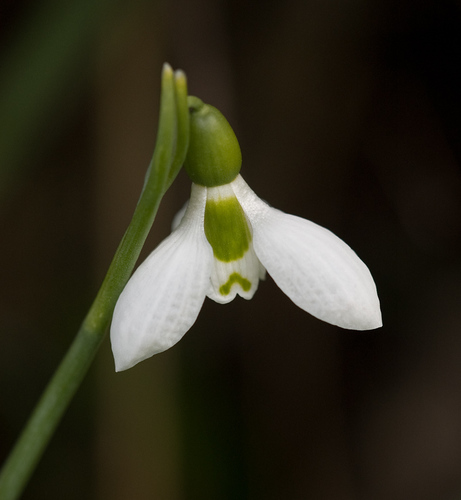
greater snowdrop
Galanthus elwesii
A defiant burst of life in the mid-winter chill, the Greater Snowdrop is easily recognized by its bold, grey-green foliage and elegant white bells. This sturdy bulb is often the first sign that spring is stirring beneath the frost.
Quick Identification
Size
Height of 10-25 cm (4-10 inches); flower size 2-3 cm (0.8-1.2 inches)
Colors
Pure white outer petals; inner petals feature two distinct green markings; foliage is a powdery grey-green (glaucous)
Key Features
- Broad, glaucous leaves that wrap around each other at the base
- Inner petals have two green marks (one at the base, one at the tip)
- Larger, more robust stature than the common snowdrop
- Nodding, bell-shaped flowers with three large outer segments
When You’ll See Them
Behavior
The greater snowdrop is one of the most resilient heralds of spring, frequently pushing through frozen ground or a layer of snow as early as January. Unlike many other flowering plants, it utilizes specialized proteins to prevent ice crystals from damaging its cell walls, allowing it to survive sudden late-winter frosts. These plants exhibit nyctinasty, a behavior where the petals close tightly at night or during cold, cloudy weather to protect their pollen, and open wide during the warmth of the day.
As a spring ephemeral, the greater snowdrop has a very fast life cycle. It emerges, blooms, and stores energy back into its bulb within a few short months before the forest canopy closes and blocks the sunlight. It shares a unique relationship with ants; its seeds possess a fleshy, nutrient-rich attachment called an elaiosome, which encourages ants to carry the seeds to their nests, effectively planting the next generation of snowdrops in nutrient-rich soil away from the parent plant.
EverydayEarth exclusive
Camera Tips
To successfully capture the greater snowdrop on a backyard or trail camera, you must think low. These plants rarely exceed 10 inches in height, so placing your camera at a 'worm’s-eye view'—about 2 to 4 inches off the ground—is essential for capturing the interior detail of the nodding bells. Use a small tripod or even a sandbag to stabilize the camera at this height. If your camera has a macro mode or a close-focus setting, this is the time to use it, as the distinguishing green markings on the inner petals are the most sought-after detail for identification.
Because snowdrops are stationary, they are the perfect subject for time-lapse photography. Set your camera to take a photo every 15 to 20 minutes during the daylight hours. This will allow you to see the dramatic 'sleep movements' of the plant as the petals open in the morning sun and close as the temperature drops in the evening. Avoid using a flash if possible, as the bright white petals are highly reflective and can easily appear as a 'blown-out' white blob in your images; natural, filtered sunlight under a tree canopy provides the best results.
Since traditional motion-activated trail cameras may not trigger for a plant, use the 'Time Lapse' or 'Field Scan' mode to ensure you don't miss the bloom. If you are specifically looking for wildlife interaction, place the camera near a clump of snowdrops on the first warm day of late winter. These flowers are a vital nectar source for the season's first emerging queen bumblebees and hoverflies. By focusing your camera on the flowers, you are likely to capture high-quality footage of these early pollinators in action.
Similar Species
Species that look similar or are commonly confused with greater snowdrop.
Frequently Asked Questions
Record greater snowdrop at your habitat
Connect a camera to start building your own species record — AI identifies every visitor automatically.