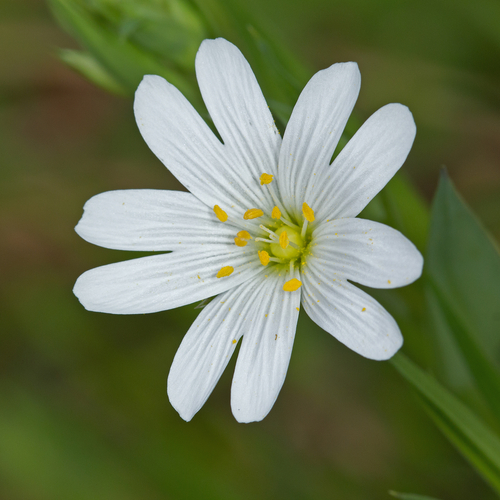
greater stitchwort
Rabelera holostea
Often called the 'Easter Bell,' the greater stitchwort transforms spring hedgerows into a sea of white stars. Its delicate, notched petals and 'popping' seed pods make it a favorite for backyard naturalists.
Quick Identification
Size
Grows 20–60 cm (8–24 inches) tall; flowers are 2–3 cm (0.8–1.2 inches) in diameter.
Colors
Brilliant snowy white petals with pale yellow or brown anthers; stems and leaves are a vibrant, grass-like green.
Key Features
- Five deeply notched petals that look like ten petals
- Square-shaped stems that are notoriously brittle
- Long, narrow, lance-shaped leaves arranged in opposite pairs
- Large, star-shaped white flowers
When You’ll See Them
Behavior
Greater stitchwort is a delicate yet hardy perennial that acts as a 'scrambler.' Because its square stems are weak and brittle, it often leans on sturdier neighbors like hawthorn or tall grasses to reach upward toward the sunlight. It is one of the most cheerful sights of the European spring, often appearing in dense, frothy white drifts along woodland floor borders.
One of its most charming 'behaviors' occurs in early summer. As the seed capsules dry out, they explode with a distinct audible 'pop' that can be heard on warm, still days. This mechanism effectively flings the seeds away from the parent plant to colonize new ground. Historically, it was called 'Addersmeat' because it was believed that snakes lived within its dense patches, though it's actually a vital nectar source for early-season hoverflies and bees.
EverydayEarth exclusive
Camera Tips
Capturing greater stitchwort on a backyard camera requires a focus on macro details and patience for pollinator visits. Because these flowers sway significantly in the slightest breeze, use a camera with a fast shutter speed or a 'sports' mode to avoid motion blur. If you are using a trail camera, mount it on a small stake just 12–18 inches off the ground, angled slightly downward to capture the 'star' shape of the blooms against the green foliage.
To get the most out of your footage, look for a patch that receives dappled morning sunlight. The brilliant white of the petals can easily 'blow out' and lose detail in harsh midday sun, so the soft light of the morning or late afternoon provides the best color balance. If your camera has a time-lapse feature, set it to take a photo every 15 minutes over a week in late April; you’ll see the dramatic way the stems climb and the flowers orient themselves toward the moving sun.
For those interested in the wildlife that visits the plant, greater stitchwort is a magnet for the Greater Bee-fly and various hoverfly species. Position your camera within its minimum focus distance (usually 1-3 feet for most trail cams) and focus on a specific cluster of 3-4 flowers. Avoid using artificial lures or baits; the nectar itself is the primary draw. Instead, ensure the area around the plant is clear of tall, distracting grass blades that might trigger the motion sensor unnecessarily.
Finally, if you want to capture the famous 'popping' seeds, switch your camera to video mode in late June. Focus on the rounded green seed heads. On a hot, dry day, the sudden movement as the pod bursts is a fantastic high-speed event to capture, though it requires a bit of luck and a high-frame-rate setting if your device supports it.
Similar Species
Species that look similar or are commonly confused with greater stitchwort.
Frequently Asked Questions
Record greater stitchwort at your habitat
Connect a camera to start building your own species record — AI identifies every visitor automatically.