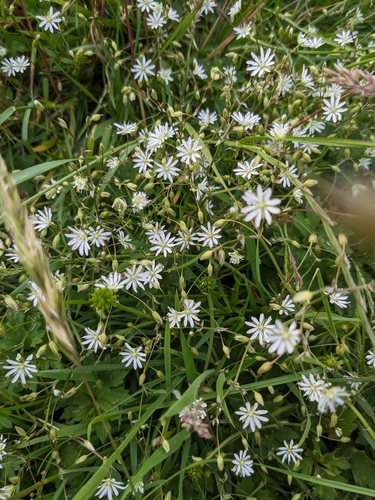
lesser stitchwort
Stellaria graminea
A delicate star among the grass, the lesser stitchwort adds a spray of white to summer meadows with its unique, deeply split petals.
Quick Identification
Size
Height: 10–50 cm (4–20 inches). Flower diameter: 5–12 mm (0.2–0.5 inches).
Colors
Brilliant white flowers; stems and leaves are a bright, grassy green.
Key Features
- Five white petals split nearly to the base, looking like ten petals
- Smooth, four-angled stems that scramble through vegetation
- Opposite pairs of narrow, grass-like leaves
- Tiny, papery bracts at the base of the flower stalks
When You’ll See Them
Behavior
The lesser stitchwort is a master of camouflage within the meadow, its thin, grass-like leaves blending seamlessly with the surrounding foliage until its starry white flowers emerge. It is a perennial herb that relies on a sprawling growth habit, using its square-edged stems to lean on sturdier plants for support. This allows it to reach the upper layers of the meadow canopy to maximize sunlight absorption without needing the thick, woody stems of larger plants.
Interaction with wildlife is primarily through its role as a nectar source. While many gardeners might overlook it as a common weed, it is a vital landing pad for small insects. It doesn't have the showy presence of a garden lily, but its sheer number of blooms across a patch of grass provides a consistent food source for hoverflies and solitary bees throughout the mid-summer months. In the garden, it usually stays to the periphery, thriving in the 'wilder' corners where the lawn meets the hedge.
EverydayEarth exclusive
Camera Tips
Capturing the beauty of lesser stitchwort requires a different approach than tracking fast-moving animals. Because these flowers are small and delicate, use a macro lens or your camera's dedicated 'macro mode' to get close-up shots of the deeply notched petals. Position your camera on a low tripod or a 'ground pod' to match the plant's height, as looking down on them from a standing position often loses the architectural detail of the square stems and the way they weave through the grass.
To capture the 'wildlife' aspect of this plant, set your camera to a high frame rate or a motion-trigger setting aimed directly at a healthy cluster of blooms. This is a fantastic way to record the hoverflies, small butterflies, and bees that frequent the flowers. Ensure you have a fast shutter speed (at least 1/500s) to freeze the motion of insect wings against the white petals. On breezy days, use a small garden stake or a specialized clamp to gently steady the stem of the plant just out of the frame, preventing motion blur from the wind.
Timelapse photography is where the lesser stitchwort truly shines on a backyard or trail camera. Set your device to take a photo every 5 to 10 minutes from dawn until dusk. When played back, you’ll see the flowers physically open and close in response to light and temperature. This reveals the 'hidden' movement of the plant that is invisible to the naked eye during a casual walk. Ensure the camera is weighted down so it doesn't shift over the several hours of the timelapse.
Lighting is the biggest challenge for white flowers like the stitchwort. Mid-day sun can often 'blow out' the highlights, making the petals look like featureless white blobs. For the best results, shoot during the 'golden hours' of early morning or late afternoon when the light is softer. If your camera allows for manual exposure compensation, try dropping it by -0.3 or -0.7 to preserve the delicate texture of the white petals against the dark green background. If using a trail camera, look for a spot with dappled shade to prevent overexposure.
Similar Species
Species that look similar or are commonly confused with lesser stitchwort.
Frequently Asked Questions
Record lesser stitchwort at your habitat
Connect a camera to start building your own species record — AI identifies every visitor automatically.